
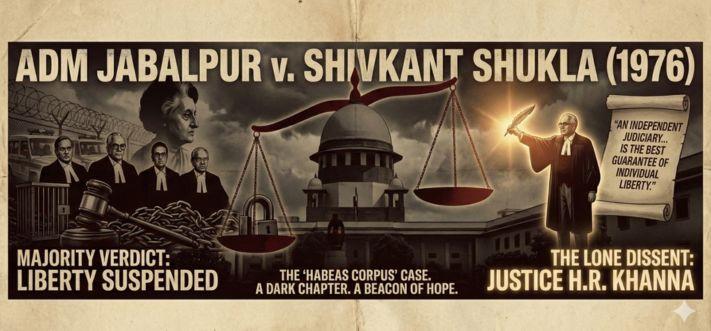
ADM Jabalpur v. Shivkant Shukla (1976) is one of the most controversial and significant judgments in Indian constitutional history. Decided during the National Emergency (1975–77), this case questioned whether citizens could approach courts for the protection of their right to life and personal liberty when Fundamental Rights were suspended.
Popularly known as the Habeas Corpus Case, the judgment is often cited as the lowest point of judicial independence in India, where the Supreme Court upheld the suspension of personal liberty during the Emergency.
Historical Background: Emergency of 1975
On 25 June 1975, then Prime Minister Indira Gandhi declared a National Emergency under Article 352 of the Constitution, citing internal disturbance. As a result:
- Fundamental Rights under Articles 14, 19, 21, and 22 were suspended
- Thousands of political leaders and citizens were detained under the Maintenance of Internal Security Act (MISA)
- Media censorship and arbitrary arrests became widespread
The President issued an order under Article 359, suspending the right to move courts for enforcement of Fundamental Rights.
Facts of the Case
Several High Courts across India received habeas corpus petitions from detenues arrested under MISA. Some High Courts (like Allahabad, Delhi, and Karnataka) held that:
- Even during Emergency, courts could examine whether detention was legal or mala fide
The government challenged these decisions, leading to the Supreme Court case ADM Jabalpur v. Shivkant Shukla.
Legal Issues Involved
The main questions before the Supreme Court were:
- Whether a person can file a writ of habeas corpus during Emergency
- Whether Article 21 (Right to Life and Personal Liberty) exists independently of Fundamental Rights
- Whether courts can review illegal detention during Emergency
Arguments by the Government
The government argued that:
- Presidential Order under Article 359 completely barred courts from entertaining habeas corpus petitions
- During Emergency, citizens had no locus standi to challenge detention
- Article 21 could not be enforced without judicial remedy
Arguments by the Petitioners
The detenues contended that:
- Right to life is a natural and inalienable right
- Even if Fundamental Rights are suspended, rule of law must prevail
- Illegal detention cannot be justified under Emergency
Judgment of the Supreme Court (4:1 Majority)
In a 4:1 majority judgment, the Supreme Court ruled in favor of the government.
Majority Opinion (Chief Justice A.N. Ray and others)
The Court held that:
- During Emergency, no person has the right to move any court for habeas corpus
- Article 21 remains suspended and cannot be enforced
- Even illegal or mala fide detention cannot be challenged
This meant that citizens had no legal protection against unlawful arrest during Emergency.
Justice H.R. Khanna’s Historic Dissent
Justice H.R. Khanna delivered one of the most celebrated dissents in Indian judicial history.
He stated:
“Even in the absence of Article 21, the State has no power to deprive a person of his life or liberty without authority of law.”
Key points of his dissent:
- Right to life is not a gift of the Constitution
- Rule of law cannot be suspended
- Courts must protect individual liberty even during Emergency
Justice Khanna’s dissent cost him the position of Chief Justice of India, but earned him lasting respect.
Impact and Criticism of the Judgment
The ADM Jabalpur judgment was widely criticized for:
- Failing to protect civil liberties
- Supporting executive tyranny
- Undermining judicial independence
Legal scholars describe it as a constitutional betrayal and a reminder of what happens when courts surrender their role as guardians of rights.
Overruling and Later Developments
1. 44th Constitutional Amendment (1978)
- Article 21 and 22 were made non-suspendable even during Emergency
- Prevented repetition of such misuse of power
2. K.S. Puttaswamy v. Union of India (2017)
The Supreme Court explicitly overruled ADM Jabalpur, stating:
- Right to life and liberty cannot be suspended
- ADM Jabalpur was wrongly decided
This restored faith in constitutional morality.
Importance for Law Students and Exams
ADM Jabalpur is crucial for:
- LL.B, BA LL.B, Judicial Services, UPSC Law Optional
- Understanding Emergency provisions
- Learning importance of dissenting opinions
- Studying evolution of Article 21
Conclusion
ADM Jabalpur v. Shivkant Shukla (1976) stands as a warning in Indian constitutional history. While the majority judgment failed to protect liberty, Justice H.R. Khanna’s dissent became the soul of the Constitution.
The case teaches that courts must remain fearless protectors of rights, especially during times of crisis. Its overruling in later years reflects India’s constitutional maturity and commitment to democracy.