
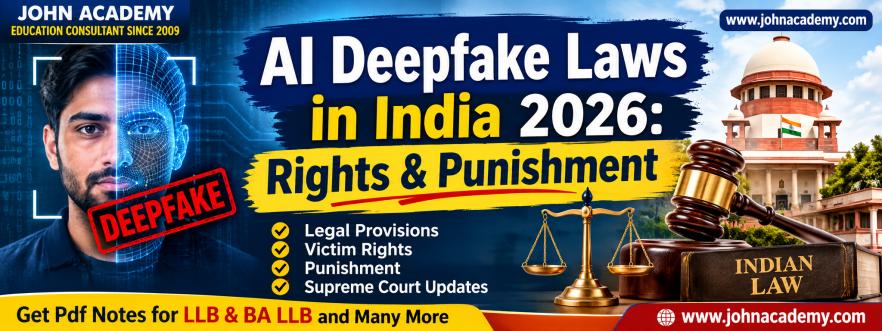
Artificial Intelligence (AI) has transformed the way people create and share digital content. Today, AI tools can generate realistic photographs, clone voices and produce videos showing people doing or saying things that never happened. Such manipulated content is commonly known as a deepfake.
Although AI has many legitimate uses in education, entertainment and research, its misuse can seriously damage a person's reputation, privacy, dignity and financial security. Deepfakes may be used for online fraud, identity theft, political misinformation, harassment and the creation of intimate images without consent.
For law students, this issue is important because it connects several areas of law, including cybercrime, criminal law, constitutional rights, privacy and intermediary liability.
As of November 2026, India does not have a single comprehensive law exclusively governing every aspect of artificial intelligence. However, existing legislation and the Information Technology (Intermediary Guidelines and Digital Media Ethics Code) Amendment Rules, 2026 provide important legal safeguards against harmful AI-generated content. The amendments came into force on 20 February 2026.
1. What Is a Deepfake Under Indian Law?
A deepfake is digital content created or manipulated using AI or other computer technology to make a person, voice, image or event appear genuine when it may be fabricated.
For example:
-
A fraudster clones a bank customer's voice to deceive a family member into transferring money.
-
Someone creates a fake video of a public figure to spread misinformation.
-
A person's face is placed into an intimate image without their consent.
-
A fake recording is circulated to damage someone's professional reputation.
The 2026 amendment to the IT Rules introduced the concept of synthetically generated information. It covers artificially or algorithmically created or altered audio, visual or audiovisual content that appears real or authentic and may be mistaken for a real person or event. Certain routine edits, accessibility improvements and legitimate educational materials are excluded where they do not materially misrepresent the underlying content.
Important legal principle: AI-generated content is not automatically illegal. Its legality depends on its nature, purpose, consent, potential harm and the applicable legal provisions.
2. Important Laws Applicable to AI Deepfakes in India
India addresses harmful deepfakes through multiple legal provisions rather than a single deepfake-specific criminal statute.
A. Information Technology Act, 2000
The Information Technology Act is one of the principal laws for dealing with cyber offences involving digital content.
|
Section |
Legal relevance |
|---|---|
|
Section 66C |
Identity theft involving fraudulent use of electronic signatures, passwords or other unique identification features. |
|
Section 66D |
Cheating by personation using a communication device or computer resource. |
|
Section 66E |
Violation of privacy through specified private images captured, published or transmitted without consent. |
|
Section 67 |
Publishing or transmitting obscene material in electronic form. |
|
Section 67A |
Publishing or transmitting material containing sexually explicit acts or conduct in electronic form. |
|
Section 69A |
Blocking public access to specified online information under the statutory procedure. |
|
Section 79 |
Conditional protection for intermediaries, subject to statutory requirements. |
These provisions may apply depending on the facts of a deepfake case. For example, a fake video used to impersonate a bank official and cheat someone may attract Section 66D. A deepfake involving obscene or sexually explicit material may attract Sections 67 or 67A where their legal requirements are satisfied.
B. Bharatiya Nyaya Sanhita, 2023
The Bharatiya Nyaya Sanhita (BNS), which came into force on 1 July 2024, may also apply to deepfake-related criminal conduct.
-
Section 318: Deals with cheating.
-
Section 319: Deals with cheating by personation.
-
Section 336: Deals with forgery, including relevant cases involving false electronic records.
-
Section 353: Addresses specified false statements, rumours or reports that may cause public mischief.
-
Section 111: Deals with organised crime where the statutory requirements are fulfilled.
The prosecution must establish the ingredients of the particular offence. Creating a fake image alone does not automatically establish every offence listed above.
3. What Punishment Can a Person Face for Creating Deepfakes?
There is no single punishment applicable to every deepfake. The penalty depends on the offence proved, the applicable section and the circumstances.
For example, Sections 66C and 66D of the IT Act provide for imprisonment of up to three years and a fine of up to ₹1 lakh for the respective offences. Section 66E provides for imprisonment of up to three years, a fine of up to ₹2 lakh, or both.
Offences involving obscene or sexually explicit electronic content can carry different penalties under Sections 67 and 67A. Additional punishment may apply under the BNS where cheating, forgery, intimidation or other offences are established.
For law students: Always distinguish between the offence's legal ingredients and its punishment. The prosecution must prove the required elements; the use of AI is not, by itself, proof of criminal liability.
4. IT Rules Amendment, 2026: New Obligations for Digital Platforms
One of the most significant developments in this area is the Information Technology (Intermediary Guidelines and Digital Media Ethics Code) Amendment Rules, 2026.
The amendment, notified on 10 February 2026 and effective from 20 February 2026, strengthens obligations concerning synthetically generated information.
Important features include:
1. Identification and labelling: Significant social media intermediaries must require relevant user declarations and apply appropriate labels to synthetically generated information, supported by suitable verification measures.
2. Technical safeguards: Platforms must deploy appropriate technical measures to address unlawful synthetic content.
3. Removal of unlawful content: The amended framework provides for removal within three hours when a qualifying court order or reasoned government intimation is received.
4. User awareness: Platforms must inform users about restrictions and consequences associated with unlawful content.
5. Platform accountability: Intermediaries must comply with applicable due-diligence requirements to retain the protection available under Section 79 of the IT Act.
These obligations do not mean that all AI-generated images, videos or audio recordings are prohibited. The law distinguishes permissible synthetic content from material that violates applicable legal requirements.
5. Important Court Decisions on AI-Generated Content
There is an important distinction for legal research: the following are High Court decisions, not Supreme Court rulings specifically on deepfakes.
A. Akira Nandan v. Sambhawaami Studios LLP (2026)
The Delhi High Court considered a dispute involving an AI-generated film that allegedly used Akira Nandan's identity without authorisation.
On 23 January 2026, the Court granted interim protection against the unauthorised exploitation of his personality through AI-generated content. The case highlighted the potential relevance of privacy, dignity and personality rights when AI tools are used to reproduce someone's identity.
Legal significance: The decision illustrates how courts can use existing legal principles to address emerging harms caused by AI-generated images and videos.
B. Jackie Shroff's Personality Rights Case (2026)
In a case concerning the unauthorised commercial use of Jackie Shroff's name, voice, image and other identifiable characteristics, the Delhi High Court granted a permanent injunction in May 2026.
The dispute included the use of his identity across digital platforms and emerging technologies, including AI.
Legal significance: The case demonstrates the growing importance of protecting personality and publicity rights against unauthorised digital exploitation.
C. Supreme Court Update: AI-Generated Fake Legal Authorities
In Pooja Ramesh Singh v. Jammu and Kashmir Bank Ltd., decided on 2 July 2026, the Supreme Court addressed the use of fictitious or AI-hallucinated judicial citations in legal proceedings.
The Court set aside the decisions affected by the reliance on non-existent or incorrectly attributed authorities and emphasised that lawyers and courts must verify legal citations. It also directed the Bar Council of India to constitute a committee to consider the issue.
This was not a deepfake case. However, it is an important Supreme Court development concerning AI and the administration of justice.
As of November 2026, the decisions discussed above should not be presented as establishing a single, comprehensive Supreme Court ruling on all deepfake-related legal issues.
6. What Legal Remedies Are Available to Deepfake Victims?
A victim of harmful AI-generated content may consider the following steps, depending on the facts:
-
Preserve screenshots, URLs, original files, timestamps and other available evidence.
-
Report the content through the platform's grievance mechanism and request removal.
-
File a complaint with the appropriate police or cybercrime authorities.
-
Consider a civil suit seeking an injunction, damages or other appropriate relief.
-
Seek urgent judicial intervention where the content causes serious or continuing harm.
India's National Cyber Crime Reporting Portal is available at cybercrime.gov.in. Complaints involving immediate threats or other urgent criminal conduct should also be reported to the appropriate authorities.
Victims should avoid unnecessarily forwarding intimate or unlawful content while preserving evidence.
7. Constitutional Rights and Deepfakes
Deepfakes raise important constitutional questions.
Article 21: The right to life and personal liberty has been interpreted to include privacy and dignity. Harmful AI-generated content may interfere with these interests.
Article 19(1)(a): Freedom of speech and expression protects legitimate expression, including criticism and satire, subject to constitutional restrictions.
The law must therefore balance individual dignity and privacy against freedom of expression. Not every parody, fictional representation or AI-generated work should be treated as unlawful. Courts must examine the context, the nature of the content, the harm caused and the applicable law.
Conclusion
AI deepfakes present new challenges for India's legal system, but existing cybercrime legislation, the BNS, intermediary rules and judicial remedies provide several ways to address unlawful conduct. The 2026 amendments to the IT Rules represent an important development in the regulation of synthetic digital content.
For law students, the central lesson is that deepfake disputes require careful application of statutory provisions, constitutional principles and evolving judicial decisions. Understanding the distinction between lawful AI creativity and unlawful impersonation is essential to analysing this emerging area of Indian law.
Frequently Asked Questions (FAQs)
1. Are deepfakes illegal in India in 2026?
Not automatically. A deepfake may be unlawful when it involves conduct such as cheating, identity theft, privacy violations, obscene publications or other prohibited acts.
2. Which law applies to deepfake crimes in India?
Depending on the circumstances, the IT Act, 2000, the Bharatiya Nyaya Sanhita, 2023, and the amended IT Rules, 2021 may apply.
3. Is there a Supreme Court judgment specifically banning deepfakes?
The Supreme Court has addressed AI-related issues, including fabricated legal authorities, but that decision is not a general ruling banning deepfakes. High Court decisions have addressed personality rights and AI-generated impersonation.
4. Can a victim seek removal of a deepfake video?
Yes. Depending on the circumstances, the victim can report the content to the platform and relevant authorities and may seek judicial relief.
Get PDF Notes for LLB and BA LLB and many more at John Academy.
Visit www.johnacademy.com for educational resources and law study materials.
Disclaimer: This article is for educational purposes only and does not constitute legal advice. Readers should consult the relevant statutory text and complete judicial orders before relying on the law in a particular case.