
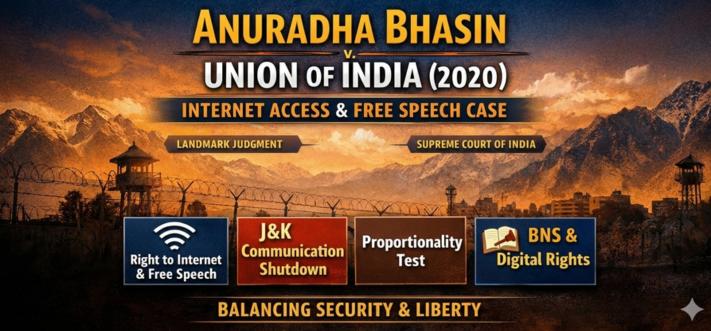
The case of Anuradha Bhasin v. Union of India (2020) is one of the most significant constitutional decisions of the Supreme Court of India in the digital age. It addressed the legality of prolonged internet shutdowns, particularly in Jammu and Kashmir, and examined whether access to the internet is protected under the right to freedom of speech and expression guaranteed by Article 19(1)(a) of the Indian Constitution. The judgment laid down crucial principles on proportionality, reasonableness, transparency, and judicial review, thereby strengthening democratic accountability in matters involving national security and civil liberties.
Background of the Case
On 5 August 2019, the Government of India revoked the special constitutional status of Jammu and Kashmir by abrogating Article 370. Anticipating public unrest, the government imposed severe restrictions, including:
- Suspension of internet services
- Restrictions on mobile and landline communications
- Prohibitory orders under Section 144 CrPC
- Detention of political leaders
Anuradha Bhasin, the Executive Editor of Kashmir Times, filed a writ petition under Article 32 of the Constitution, arguing that the internet shutdown:
- Violated freedom of speech and expression (Article 19(1)(a))
- Affected the right to practice any profession or trade (Article 19(1)(g))
- Was imposed without publishing the relevant orders, violating procedural fairness
Issues Before the Supreme Court
The Supreme Court considered the following key issues:
- Whether freedom of speech and expression includes the right to access the internet
- Whether indefinite suspension of internet services is constitutionally valid
- Whether the government can impose restrictions without publishing orders
- Whether such restrictions satisfy the test of proportionality
Arguments of the Petitioners
The petitioners contended that:
- The internet is an essential medium for journalism, trade, education, and democratic discourse
- A blanket and indefinite ban is arbitrary and excessive
- Restrictions failed to meet the standards of reasonableness under Article 19(2)
- Non-publication of orders violated the principles of natural justice
Arguments of the Government
The Union of India argued that:
- The restrictions were imposed in the interest of national security and public order
- Preventing the spread of misinformation and terrorism justified the measures
- Courts should show judicial restraint in matters of security
- Temporary suspension of internet services is permissible under law
Judgment of the Supreme Court
The Supreme Court delivered a balanced and nuanced judgment, recognizing both civil liberties and national security concerns.
1. Internet Access and Freedom of Speech
The Court held that:
Freedom of speech and expression under Article 19(1)(a) includes the right to disseminate and receive information through the internet.
Although the Court stopped short of declaring internet access a fundamental right in itself, it clearly stated that any restriction on internet access directly affects fundamental rights.
2. Indefinite Internet Shutdowns Are Unconstitutional
The Court ruled that:
- Indefinite suspension of internet services is impermissible
- Suspension must be:
- Temporary
- Necessary
- Proportionate
This principle has far-reaching implications, especially in the context of frequent internet shutdowns across India.
3. Doctrine of Proportionality
The Court applied the proportionality test, requiring that:
- The measure must pursue a legitimate aim
- There must be a rational connection between the measure and the objective
- There must be no less restrictive alternative
- The restriction must strike a balance between rights and public interest
The Court emphasized that blanket bans fail this test.
4. Mandatory Publication of Orders
The Court held that:
All orders imposing restrictions must be published and made accessible to the public.
This ensures:
- Transparency
- Judicial review
- Accountability of executive action
Legal Provisions Involved
- Article 19(1)(a) – Freedom of speech and expression
- Article 19(1)(g) – Right to trade and profession
- Article 19(2) – Reasonable restrictions
- Article 32 – Right to constitutional remedies
- Telegraph Act, 1885
- Temporary Suspension of Telecom Services (Public Emergency or Public Safety) Rules, 2017
Relevance Under Bharatiya Nyaya Sanhita (BNS), 2023
Although the case predates the Bharatiya Nyaya Sanhita, 2023, its principles are highly relevant under the new criminal justice framework:
- BNS emphasizes constitutional morality and proportionality in penal action, aligning with the Court’s insistence on reasoned executive orders.
- Several public order and security-related offences under BNS must now be enforced with due regard to fundamental rights, especially speech and expression.
- The judgment acts as a constitutional safeguard against misuse of broad powers affecting digital freedoms.
- Under BNS, arbitrary or excessive restrictions impacting civil liberties can be challenged more effectively using the Anuradha Bhasin principles.
Thus, the case acts as a constitutional compass for applying BNS provisions in a rights-respecting manner.
Critical Analysis
Strengths
- Recognized the internet as central to modern free speech
- Established clear limits on executive power
- Reinforced judicial review and transparency
Limitations
- Did not explicitly declare internet access as a separate fundamental right
- Left significant discretion with the executive in security matters
Impact and Significance
- Set the first authoritative precedent on internet shutdowns in India
- Strengthened digital rights jurisprudence
- Frequently cited in later cases challenging shutdowns
- Influenced policy debates on internet governance and democracy
Conclusion
Anuradha Bhasin v. Union of India (2020) marks a turning point in Indian constitutional law by recognizing the internet as an essential medium for exercising fundamental rights. The judgment ensures that while the State may act to protect national security, such action must always be lawful, proportionate, transparent, and subject to judicial scrutiny. In the era of the Bharatiya Nyaya Sanhita, 2023, this case continues to serve as a vital safeguard against executive overreach and a strong affirmation of democratic freedoms in the digital age.