
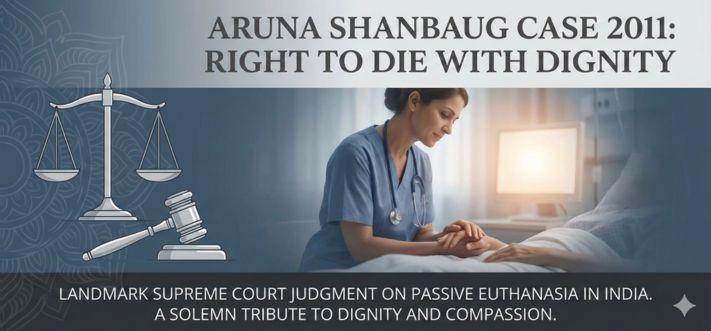
The Aruna Shanbaug case of 2011 is one of the most significant milestones in Indian legal history, especially in the domain of human rights and medical ethics. It brought into sharp focus the controversial and sensitive issue of the right to die with dignity and laid down guidelines for passive euthanasia in India. This case not only challenged societal notions of life and death but also highlighted the role of the judiciary in balancing human dignity, ethics, and legal principles.
Background of Aruna Shanbaug
Aruna Shanbaug was a nurse working at King Edward Memorial (KEM) Hospital, Mumbai. On November 27, 1973, she was brutally attacked by a ward boy, resulting in severe brain damage. The attack left her in a persistent vegetative state (PVS), unable to speak, move, or live independently. Despite the tragedy, she continued to live in the hospital for over 37 years, cared for by hospital staff who treated her as a patient and a human being.
Aruna’s condition sparked a nationwide debate over quality of life and ethical responsibility. Was it morally and legally permissible to end her life to relieve her suffering, or should she continue to live in her vegetative state?
Legal Journey
In 2009, Pinki Virani, a journalist, filed a petition in the Supreme Court of India, seeking permission for passive euthanasia for Aruna Shanbaug. She argued that continuing life support for someone in a PVS amounted to unnecessary suffering. Pinki Virani’s petition became a public and legal debate about whether individuals in vegetative states should have the right to die under Indian law.
At that time, India had no clear law on euthanasia, and active euthanasia (intentionally causing death) was illegal under Section 302 of the Indian Penal Code. However, the question remained whether withdrawing medical treatment in certain circumstances could be legally allowed.
Supreme Court Judgment (2011)
The Supreme Court of India delivered its judgment on March 7, 2011, in the case Pinki Virani v. Union of India & Ors. The court refused permission for euthanasia in Aruna Shanbaug’s case but recognized the legal validity of passive euthanasia under strict conditions.
Key Highlights of the Judgment
- Recognition of Passive Euthanasia:
The Supreme Court ruled that passive euthanasia, which involves the withdrawal of life-supporting medical treatment to allow a patient to die naturally, is legal in India under strict guidelines. - Conditions for Passive Euthanasia:
The court outlined that passive euthanasia can only be permitted:- For patients in a persistent vegetative state (PVS) or terminally ill.
- When a medical board of at least three doctors confirms the patient’s condition.
- Approval of the High Court is mandatory before any withdrawal of treatment.
- Refusal of Euthanasia in Aruna’s Case:
Despite legal recognition of passive euthanasia, the Supreme Court denied Pinki Virani’s petition for Aruna Shanbaug. The court noted that Aruna was well cared for, loved, and had meaningful human interaction with hospital staff. Thus, ending her life was not in her best interest. - Protection of Caregivers:
The court also highlighted that withdrawing treatment without following the proper procedure could lead to criminal liability. This judgment protected both the dignity of patients and the ethical duties of caregivers.
Moral and Legal Principles Established
- Right to Life Includes Right to Die with Dignity:
The Supreme Court reaffirmed that Article 21 of the Constitution, which guarantees the right to life, also includes the right to live with dignity. Passive euthanasia is a step towards upholding human dignity by preventing unnecessary suffering. - Judicial Safeguards:
The requirement of High Court approval and medical board certification ensures that euthanasia is not misused and is applied only in extreme and ethically justified cases. - Difference Between Active and Passive Euthanasia:
The court clearly distinguished active euthanasia (illegal) from passive euthanasia (conditionally legal). Active euthanasia involves actively causing death, whereas passive euthanasia allows natural death by withholding or withdrawing treatment.
Impact of the Case on Indian Society
The Aruna Shanbaug case sparked widespread discussion on end-of-life care, medical ethics, and patients’ rights. It also highlighted the role of hospitals and caregivers in providing dignity and compassion to those in vegetative states.
After this case, there was increased awareness about living wills (advance directives) in India. Though initially controversial, in 2018, the Supreme Court legalized living wills, allowing individuals to outline their wishes regarding medical treatment in case of terminal illness or PVS. This development can be traced back to the ethical and legal debates sparked by the Aruna Shanbaug case.
Criticism and Ethical Debates
While the case is celebrated as a landmark judgment, it has also faced criticism:
- Delay in Justice: Aruna remained in PVS for 37 years before the legal system addressed the issue.
- Ethical Concerns: Some argued that denying euthanasia might prolong suffering, while others believed that human life must be preserved at all costs.
- Media Controversy: The way media reported the case often sensationalized Aruna’s condition, raising questions about privacy and ethics.
Legacy of the Judgment
The Aruna Shanbaug case remains a cornerstone in Indian jurisprudence on right to die and passive euthanasia. Its legacy can be summarized as:
- Legal Recognition: Passive euthanasia is legally recognized under Indian law, subject to judicial oversight.
- Human Dignity: Reinforced that life is not just biological existence but also dignified living.
- Ethical Framework: Hospitals and caregivers are guided on ethical and legal standards for end-of-life care.
- Foundation for Future Laws: Paved the way for the Mental Healthcare Act, 2017, and recognition of advance directives in 2018.
Conclusion
The Aruna Shanbaug case is more than a legal judgment—it is a reflection of human compassion, ethics, and constitutional philosophy. By balancing the right to life, dignity, and protection of human rights, the Supreme Court created a framework for end-of-life care in India.
This case demonstrates that law is not just about rules but also about moral responsibility and social values. It reminds society that while medical science can prolong life, quality of life and dignity must remain paramount. Aruna Shanbaug’s life and the Supreme Court’s judgment continue to inspire debates, policies, and legal reforms on passive euthanasia, living wills, and patients’ rights in India.
Ultimately, the Aruna Shanbaug case teaches us that respect for human dignity is the foundation of justice, and even in the face of tragedy, the law can provide a compassionate path forward.