
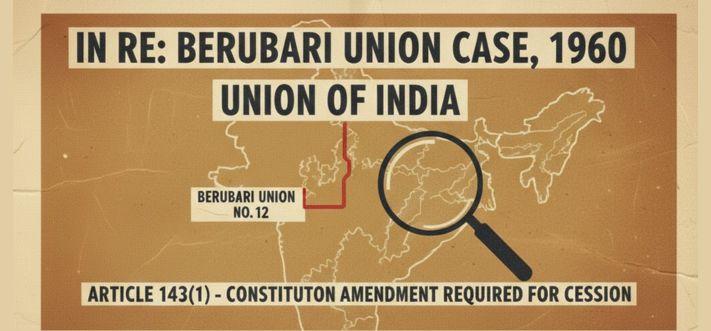
The Berubari Union Case (1960) is a landmark constitutional case decided by the Supreme Court of India that clarified the procedure for ceding Indian territory to a foreign country. The case arose out of a dispute between India and Pakistan regarding the Berubari Union, a small territory located in the district of Jalpaiguri, West Bengal. The judgment is significant because it interpreted Article 3, Article 368, and Article 1 of the Indian Constitution and established that Parliament alone cannot transfer Indian territory without a constitutional amendment.
Background of the Case
After independence in 1947, the Radcliffe Award divided British India into India and Pakistan. Due to ambiguous demarcation, disputes arose regarding certain border areas, including Berubari Union No. 12.
To resolve the dispute, the Nehru–Noon Agreement (1958) was signed between India and Pakistan. According to this agreement:
- Berubari Union would be divided equally between India and Pakistan
- Certain enclaves would be exchanged
However, serious constitutional questions arose regarding whether the Government of India had the authority to transfer Indian territory to Pakistan.
Presidential Reference under Article 143
To resolve the constitutional doubts, the President of India made a reference to the Supreme Court under Article 143(1) (Advisory Jurisdiction).
Questions Referred
- Whether Parliament could implement the Nehru–Noon Agreement by law under Article 3?
- Whether a constitutional amendment under Article 368 was necessary to transfer Indian territory?
Issues Before the Supreme Court
The main constitutional issues were:
- Does Article 3 of the Constitution empower Parliament to cede Indian territory to a foreign country?
- Is a constitutional amendment mandatory for transferring Indian territory?
- What is the relationship between Articles 1, 3, and 368?
Arguments
Government of India’s Argument
- Article 3 allows Parliament to alter the boundaries of states.
- Ceding territory is a form of boundary adjustment.
- Therefore, a simple parliamentary law would suffice.
Opposing View
- Article 3 only deals with internal reorganization.
- Transfer of territory affects Article 1, which defines India’s territory.
- Hence, a constitutional amendment is required.
Judgment of the Supreme Court
The Supreme Court, in its advisory opinion, held that Parliament cannot cede Indian territory to a foreign country under Article 3.
Key Findings
1. Article 3 is Limited in Scope
- Article 3 allows Parliament to:
- Form new states
- Alter boundaries of existing states
- It applies only to internal territorial reorganization
- It does not permit cession of Indian territory to a foreign state
2. Article 1 is Affected
- Article 1 describes the territory explained in the First Schedule
- Any transfer of territory changes the description of India
- Hence, Article 1 must be amended
3. Constitutional Amendment is Mandatory
- Since Article 1 is a fundamental provision, it can only be altered through Article 368
- A constitutional amendment passed by:
- Special majority in Parliament
- Ratification by states (where applicable)
is required
4. Executive Agreement is Insufficient
- International treaties or agreements cannot override the Constitution
- The Nehru–Noon Agreement required constitutional backing
Final Opinion of the Court
“The implementation of the Nehru–Noon Agreement in so far as it involves the cession of Indian territory requires an amendment of the Constitution under Article 368.”
Significance of the Berubari Union Case
1. Clarified Constitutional Supremacy
- International agreements must conform to the Constitution
- Executive power is subordinate to constitutional provisions
2. Defined Limits of Parliamentary Power
- Parliament’s power under Article 3 is not absolute
- Cession of territory is different from reorganization
3. Strengthened Federal Structure
- States cannot lose territory without constitutional safeguards
- Protects territorial integrity of India
4. Set a Precedent for Future Cases
- Followed in later cases involving territory and sovereignty
- Influenced the 9th Constitutional Amendment Act, 1960
Aftermath: 9th Constitutional Amendment Act, 1960
To give effect to the Nehru–Noon Agreement, Parliament enacted the 9th Constitutional Amendment, which:
- Amended the First Schedule
- Transferred Berubari Union to Pakistan
- Resolved the constitutional issue lawfully
Critical Analysis
Positive Aspects
- Ensured strict adherence to constitutional procedures
- Prevented misuse of executive power
- Preserved democratic accountability
Criticism
- Made diplomatic settlements more complex
- Slowed down international dispute resolution
However, the Court rightly prioritized constitutional integrity over administrative convenience.
Conclusion
The Berubari Union Case (1960) is a cornerstone of Indian constitutional law. It firmly established that Indian territory cannot be ceded to a foreign country without a constitutional amendment. The judgment reinforced the supremacy of the Constitution, limited parliamentary powers under Article 3, and safeguarded India’s territorial integrity. Even today, the case remains a vital reference point for understanding the relationship between sovereignty, federalism, and constitutional procedure.