
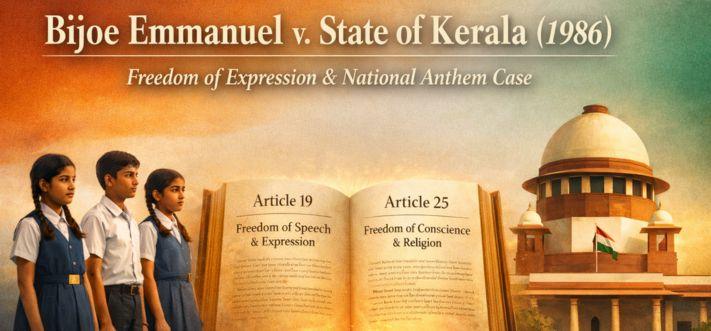
The Supreme Court judgment in Bijoe Emmanuel v. State of Kerala (1986) is a landmark decision that strengthened the scope of freedom of speech and expression and freedom of conscience under the Indian Constitution. Popularly known as the National Anthem Case, it addressed a sensitive issue: whether students can be punished for respectfully refusing to sing the National Anthem due to their religious beliefs.
The case reaffirmed that constitutional patriotism is rooted in tolerance, dignity, and individual liberty, not forced conformity. Even decades later, this judgment remains relevant, especially in the context of rising debates on nationalism, dissent, and individual rights. Its principles also align with the modern philosophy behind the Bharatiya Nyaya Sanhita (BNS), 2023, which emphasizes proportionality, intent, and constitutional values in criminal law.
Facts of the Case
Three school children belonging to the Jehovah’s Witnesses faith were studying in a school in Kerala. Their religious belief prohibited them from singing any song or anthem other than prayers to God.
However, out of respect, the children stood up silently when the National Anthem was sung during the morning assembly. They did not cause any disturbance or show disrespect.
Despite this, the school authorities expelled the children on the ground that refusal to sing the National Anthem was anti-national and violated discipline.
Their father, Bijoe Emmanuel, approached the Supreme Court under Article 32 of the Constitution, challenging the expulsion as a violation of fundamental rights.
Issues Before the Court
The Supreme Court considered the following key issues:
- Whether the expulsion of the children violated Article 19(1)(a) (Freedom of Speech and Expression).
- Whether the action infringed Article 25 (Freedom of Conscience and Religion).
- Whether standing silently during the National Anthem amounts to disrespect under law.
- Whether the State can compel individuals to sing the National Anthem.
Constitutional Provisions Involved
- Article 19(1)(a) – Freedom of speech and expression
- Article 25(1) – Freedom of conscience and free profession of religion
- Article 51A(a) – Fundamental duty to respect the National Anthem
The Court carefully balanced fundamental rights with fundamental duties, making this judgment constitutionally significant.
Judgment of the Supreme Court
A three-judge bench of the Supreme Court allowed the petition and held that the expulsion of the children was unconstitutional.
The Court ruled that:
- There is no law that obliges a person to sing the National Anthem.
- The children had shown respect by standing silently.
- Compelling them to sing violated their freedom of conscience under Article 25.
- Their silence did not amount to disrespect under the law.
The Court emphasized that tolerance is the hallmark of Indian democracy.
Key Observations of the Court
Justice O. Chinnappa Reddy made several powerful observations:
- “Our tradition teaches tolerance; our philosophy preaches tolerance; our Constitution practices tolerance.”
- True patriotism does not require forced participation.
- The State cannot prescribe how citizens should express respect, unless there is a clear violation of law.
This judgment rejected the idea that nationalism can be imposed through coercion.
Freedom of Expression and Negative Expression
An important contribution of this case is the recognition of negative freedom of expression—the right not to speak.
Freedom of speech under Article 19(1)(a) includes:
- The right to speak
- The right to remain silent
The children’s silence was itself a constitutionally protected form of expression.
Relationship with Fundamental Duties
Article 51A(a) requires citizens to respect the National Anthem. The Court clarified that:
- Fundamental duties are moral obligations, not enforceable penal commands.
- Respect does not necessarily mean singing.
- Standing in silence is a valid form of respect.
Thus, fundamental duties cannot override fundamental rights.
Relevance under Bharatiya Nyaya Sanhita (BNS), 2023
Although the case was decided under the constitutional framework, its principles are highly relevant under the BNS, 2023, which has replaced the IPC.
1. Mens Rea (Intent) under BNS
The BNS focuses strongly on criminal intent.
In Bijoe Emmanuel’s case:
- There was no intention to insult the nation.
- The act was respectful and peaceful.
Under BNS principles, absence of mens rea means no criminal liability.
2. Proportionality and Fairness
BNS reflects modern criminal law values such as:
- Proportional punishment
- Avoidance of criminalisation of harmless conduct
Expelling children for silent respect would be grossly disproportionate under BNS philosophy.
3. Constitutional Alignment
BNS is expected to operate in harmony with:
- Articles 19 and 25
- Supreme Court interpretations of liberty and dignity
Any offence relating to national symbols must be interpreted strictly, ensuring no violation of fundamental rights.
Significance of the Judgment
The case is significant because it:
- Protects minority religious rights
- Expands the scope of freedom of expression
- Reinforces constitutional morality
- Prevents misuse of nationalism as a tool of oppression
- Guides interpretation of criminal law under modern statutes like BNS
Contemporary Relevance
Even today, citizens face legal and social pressure regarding expressions of nationalism. This judgment acts as a constitutional safeguard against mob mentality and excessive state action.
Courts continue to rely on Bijoe Emmanuel to ensure that:
- Patriotism remains voluntary
- Law respects diversity
- Criminal law does not punish belief or silence
Conclusion
Bijoe Emmanuel v. State of Kerala (1986) is a timeless constitutional judgment that upholds the essence of Indian democracy—unity without uniformity. It teaches that respect for the nation flows from freedom, dignity, and conscience, not from fear or force.
In the era of Bharatiya Nyaya Sanhita, 2023, this case serves as a guiding light, reminding lawmakers, administrators, and citizens that criminal law must always bow to constitutional values.
True nationalism lies not in compelled slogans, but in protecting the freedoms that define India.