
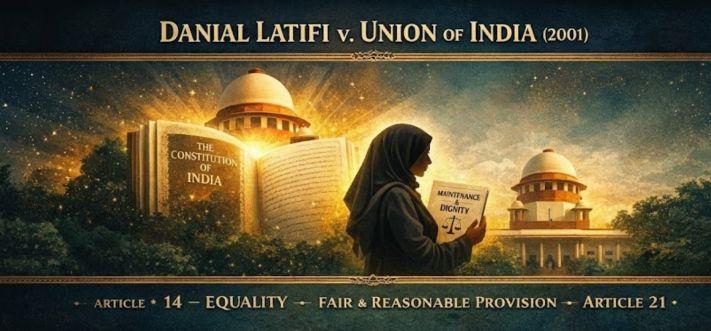
The Supreme Court judgment in Danial Latifi v. Union of India (2001) is one of the most significant landmark decisions relating to Muslim women’s rights after divorce in India. This case provided a constitutional interpretation of the Muslim Women (Protection of Rights on Divorce) Act, 1986, and harmonized it with the principles of Articles 14, 15, and 21 of the Constitution of India.
The judgment ensured that divorced Muslim women are not left destitute and reaffirmed the judiciary’s commitment to gender justice, dignity, and social welfare, while respecting religious personal laws.
Background of the Case
The controversy surrounding the Muslim Women Act arose after the historic Shah Bano Begum v. Union of India (1985) judgment. In Shah Bano, the Supreme Court held that a divorced Muslim woman is entitled to maintenance under Section 125 of the Code of Criminal Procedure, 1973 (CrPC) if she is unable to maintain herself.
This decision triggered political and religious debates, leading to the enactment of the Muslim Women (Protection of Rights on Divorce) Act, 1986, which appeared to restrict a Muslim husband’s liability to provide maintenance only during the iddat period.
Several petitions were filed challenging the constitutional validity of the Act. Danial Latifi, a lawyer and women’s rights activist, filed a writ petition under Article 32, arguing that the Act violated fundamental rights of Muslim women.
Issues Before the Court
The Supreme Court considered the following key issues:
- Whether the Muslim Women (Protection of Rights on Divorce) Act, 1986 is unconstitutional?
- Whether a Muslim husband’s liability to provide maintenance is limited only to the iddat period?
- Whether the Act violates Articles 14 (Equality), 15 (Non-discrimination), and 21 (Right to Life and Dignity) of the Constitution?
- How should the provisions of the Act be interpreted to protect divorced Muslim women?
Relevant Provisions of the Muslim Women Act, 1986
- Section 3(1)(a): A divorced Muslim woman is entitled to a “reasonable and fair provision and maintenance” to be made and paid to her within the iddat period by her former husband.
- Section 4: If the woman is unable to maintain herself after iddat, maintenance can be claimed from relatives or the Wakf Board.
The central debate was the interpretation of the phrase “reasonable and fair provision and maintenance”.
Arguments of the Petitioners
- The Act discriminates against Muslim women by denying them long-term maintenance.
- Limiting maintenance to the iddat period violates Article 21, as it threatens the right to live with dignity.
- The Act negates the beneficial interpretation of Section 125 CrPC, which is a secular provision applicable to all citizens.
- The Act is arbitrary and violates Article 14.
Arguments of the Union of India
- The Act is a valid piece of legislation based on Muslim personal law.
- The husband’s obligation is confined to the iddat period.
- The Act provides alternative remedies under Section 4.
- Religious freedom under Article 25 must be respected.
Judgment of the Supreme Court
The Supreme Court, in a unanimous decision, upheld the constitutional validity of the Muslim Women Act, but gave it a progressive and rights-oriented interpretation.
Key Findings
- Maintenance Is Not Limited to Iddat Period
The Court held that the husband’s obligation is not restricted to providing maintenance only during the iddat period. - Meaning of “Reasonable and Fair Provision”
The term means a lump sum or adequate provision that must take care of the divorced woman’s future needs, including food, shelter, clothing, and residence. - Timing, Not Duration
The provision must be made within the iddat period, but it is meant to support the woman for her entire life or until she remarries. - Harmonious Construction with Constitution
The Act must be interpreted in a manner consistent with Articles 14 and 21, ensuring equality and dignity. - No Conflict with Shah Bano
The Court clarified that the Act does not overturn Shah Bano; instead, it reaffirms the obligation of the husband in a different legal form.
Constitutional Significance
The judgment is a classic example of judicial balancing between personal law and fundamental rights. The Court avoided striking down the Act but ensured that it does not become a tool of oppression.
- Article 14: Prevents arbitrary deprivation of maintenance.
- Article 21: Guarantees dignified life to divorced Muslim women.
- Article 15(3): Allows special provisions for women.
Relevance Under the BNS / BNSS Framework
With the introduction of new criminal law codes:
- CrPC, 1973 has been replaced by the Bharatiya Nagarik Suraksha Sanhita, 2023 (BNSS).
- The provision relating to maintenance (earlier Section 125 CrPC) now continues in BNSS with the same social justice objective.
Although Danial Latifi was decided under the CrPC regime, its principle of social welfare and gender justice remains fully applicable under the BNSS framework. The judgment reinforces that maintenance laws are not punitive but protective, aligning with the spirit of modern criminal jurisprudence under BNS/BNSS.
Impact of the Judgment
- Strengthened the economic security of divorced Muslim women.
- Prevented misuse of religious personal law to deny basic rights.
- Set a precedent for progressive interpretation of welfare legislation.
- Influenced later judgments on women’s rights and maintenance.
Critical Analysis
The judgment has been widely appreciated for avoiding judicial overreach while ensuring justice. However, critics argue that reliance on lump-sum provision may still lead to enforcement challenges. Despite this, Danial Latifi remains a milestone in Indian constitutional jurisprudence.
Conclusion
Danial Latifi v. Union of India (2001) is a landmark judgment that reaffirmed the Supreme Court’s role as the guardian of fundamental rights. By interpreting the Muslim Women Act in a constitutional and humane manner, the Court ensured that divorced Muslim women are not denied their right to dignity, equality, and livelihood.
The case stands as a powerful reminder that law must evolve with constitutional values, and personal laws cannot operate in isolation from fundamental rights. Even in the era of the BNS and BNSS, the principles laid down in Danial Latifi continue to guide courts in delivering gender-just and socially responsive justice.