
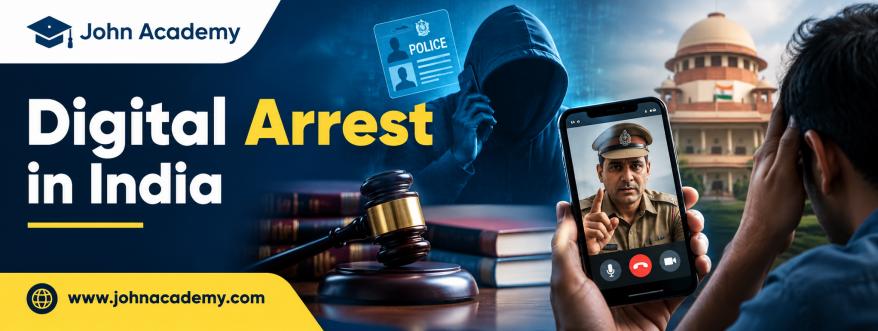
Digital Arrest is an emerging form of cybercrime in India in which fraudsters impersonate police officers, Central Bureau of Investigation (CBI) officials, Enforcement Directorate (ED) officers, judges or other government authorities. They threaten innocent people with arrest, criminal prosecution or property seizure through phone calls and video conferencing applications such as WhatsApp and Skype.
The victims are often forced to remain on video calls for several hours or days and are pressured into transferring money under the false pretext of investigation or financial verification.
Digital arrest is not a legally recognised form of arrest under Indian law. It is a fraudulent technique used by cybercriminals to commit cheating, extortion, impersonation and other offences.
1. What Is Digital Arrest?
Digital Arrest refers to a fraudulent practice in which cybercriminals create an illusion that a person is under investigation or has been digitally detained by a law enforcement agency.
Scammers may claim that:
-
A parcel containing illegal drugs or fake passports has been booked in the victim's name.
-
The victim's Aadhaar card or mobile number has been misused.
-
The victim's bank account is connected with money laundering.
-
A criminal case or arrest warrant has been issued against the victim.
-
The victim must transfer money for verification or clearance.
Fraudsters sometimes display fake identity cards, forged court orders, police uniforms and fabricated documents to make their threats appear genuine.
Important: There is no provision under Indian law that allows police officers or investigating agencies to arrest a person digitally through a WhatsApp or Skype video call.
2. How Does a Digital Arrest Scam Work?
Digital arrest scams generally follow a systematic pattern:
Step 1: Initial Contact
The victim receives a phone call from someone pretending to be a police officer, CBI official, TRAI representative or courier company employee.
Step 2: False Allegations
The caller claims that the victim is involved in serious criminal activities, such as drug trafficking, identity theft or money laundering.
Step 3: Fake Legal Proceedings
The fraudster may send forged arrest warrants, government identity cards or fabricated legal notices to create fear.
Step 4: Video Call Surveillance
The victim is instructed to remain continuously connected through a video call. The fraudster may prohibit the victim from contacting family members or friends.
Step 5: Financial Extortion
The victim is instructed to transfer money to a specified bank account for so-called verification, security deposits or clearance.
Once the money is transferred, the criminals may disappear or demand additional payments.
3. Legal Provisions Applicable to Digital Arrest in India
Although digital arrest is not a separate offence specifically defined under Indian law, several provisions of the Bharatiya Nyaya Sanhita, 2023 (BNS) and Information Technology Act, 2000 may apply depending on the facts of the case.
A. Bharatiya Nyaya Sanhita, 2023 (BNS)
The following provisions are particularly relevant:
| Section | Offence |
|---|---|
| Section 204 | Personating a public servant |
| Section 308 | Extortion |
| Section 318 | Cheating |
| Section 319 | Cheating by personation |
| Section 336 | Forgery |
| Section 338 | Forgery of valuable security, will, etc. |
| Section 340 | Forged document or electronic record and using it as genuine |
| Section 61 | Criminal conspiracy |
The precise applicability and punishment depend on the conduct, evidence and circumstances of each case.
B. Information Technology Act, 2000
The Information Technology Act also provides important legal remedies against cybercriminals.
| Section | Legal provision |
|---|---|
| Section 66C | Identity theft |
| Section 66D | Cheating by personation using computer resources |
| Section 43 | Unauthorised access and damage to computer systems |
| Section 66 | Computer-related offences involving acts under Section 43 done dishonestly or fraudulently |
For example, when criminals use another person's identity or electronic credentials to commit fraud, Sections 66C and 66D may become relevant.
4. Supreme Court Guidelines and Important Developments
The Supreme Court of India has taken serious note of digital arrest scams, particularly cases involving senior citizens who have lost their life savings.
In 2025, the Supreme Court initiated suo motu proceedings titled In Re: Victims of Digital Arrest Related to Forged Documents, Suo Motu Writ Petition (Criminal) No. 3 of 2025.
The proceedings arose after a senior citizen couple complained that fraudsters impersonating CBI officers, Enforcement Directorate officials and judicial authorities had threatened them using forged Supreme Court documents and forced them to transfer approximately ₹1.05 crore.
The Supreme Court's order dated 1 December 2025 recorded the seriousness and organised nature of these fraudulent activities. The Court directed the CBI to undertake investigation into the matter and called for coordinated action by relevant authorities.
Further proceedings, including the order dated 16 December 2025, considered the problems faced by victims and proposals for stronger preventive measures.
Important areas addressed in the proceedings include:
-
Investigation and coordination: Strengthening cooperation between the CBI, State Police and cybercrime authorities.
-
Banking safeguards: Considering stronger mechanisms to detect and prevent suspicious financial transfers.
-
Telecommunications: Examining measures to prevent misuse of SIM cards and telephone connections.
-
Victim assistance: Considering measures for victim compensation and support.
-
Inter-agency cooperation: Improving coordination among law enforcement agencies, financial institutions and telecommunications authorities.
These proceedings are important for understanding the growing judicial response to organised digital fraud in India.
5. Constitutional Rights of Digital Arrest Victims
Digital arrest scams can seriously affect the liberty, dignity and financial security of individuals.
Several constitutional provisions are relevant:
Article 14 – Right to Equality: Protects individuals against arbitrary State action.
Article 21 – Right to Life and Personal Liberty: Protects life and personal liberty except according to procedure established by law.
Article 22 – Protection Against Arrest and Detention: Provides safeguards relating to arrest, including the right to be informed of grounds of arrest and the right to consult a legal practitioner.
These constitutional safeguards apply to lawful State action. A scammer pretending to be a police officer cannot exercise the powers of the State.
6. Difference Between Real Arrest and Digital Arrest
| Real Arrest | Digital Arrest Scam |
|---|---|
| Conducted under legal authority | Conducted by fraudsters |
| Follows legal procedure | Uses threats and deception |
| Based on applicable law | Based on fabricated allegations |
| Involves lawful custody | Uses video calls to create fear |
| Does not require payment for release | Demands money from victims |
7. What Should You Do If You Receive a Digital Arrest Call?
If you receive a suspicious call claiming that you are digitally arrested, follow these precautions:
-
Do not panic or follow threats made by unknown callers.
-
Never transfer money for so-called police verification or clearance.
-
Do not share Aadhaar details, bank information, OTPs or passwords.
-
Disconnect the suspicious call and independently verify the caller's identity through official channels.
-
Preserve call recordings, phone numbers, messages, screenshots and transaction details where lawfully available.
-
Inform your bank immediately if money has been transferred.
-
Report financial cyber fraud immediately by calling 1930.
-
Submit a complaint through the National Cyber Crime Reporting Portal: https://cybercrime.gov.in.
Prompt reporting may help authorities and banks take steps to trace or freeze fraudulent transactions, although recovery is not guaranteed.
8. Role of the National Cyber Crime Reporting Portal
The Government of India provides the National Cyber Crime Reporting Portal to enable citizens to report cybercrime complaints.
The portal allows individuals to report online financial fraud, identity theft, impersonation, social media-related offences and other cybercrime incidents.
The Indian Cyber Crime Coordination Centre (I4C) also works towards improving coordination and strengthening the country's response to cybercrime.
Conclusion
Digital arrest is a serious form of cybercrime that exploits fear, legal ignorance and trust in government institutions. Fraudsters misuse the names of police departments, CBI, ED and courts to intimidate innocent citizens and extract money.
Indian law provides several provisions under the Bharatiya Nyaya Sanhita, 2023 and Information Technology Act, 2000 to deal with the criminal activities involved in these scams. The Supreme Court's suo motu proceedings have also highlighted the need for stronger investigation, institutional coordination and victim protection.
Every citizen should remember that digital arrest is not a recognised legal procedure in India. Awareness, timely reporting and verification of suspicious communications are essential to prevent such cyber frauds.
Disclaimer: This article is intended for educational and legal awareness purposes, particularly for law students and AIBE aspirants. It does not constitute individual legal advice. Readers should consult the applicable statutory provisions and judicial orders for specific legal matters.