
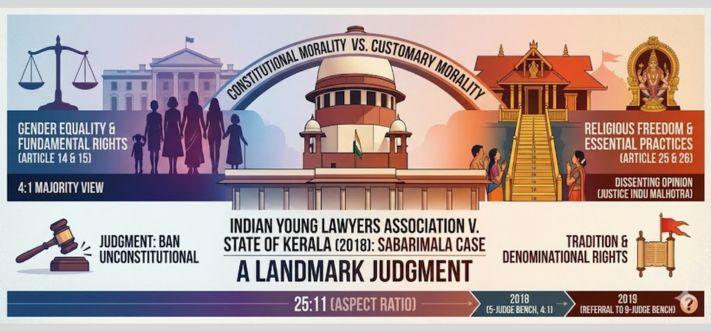
The Supreme Court judgment in Indian Young Lawyers Association v. State of Kerala (2018) is one of the most transformative and debated constitutional decisions in Indian legal history. Popularly known as the Sabarimala Temple case, the verdict addressed the long-standing restriction on the entry of women aged 10 to 50 years into the Sabarimala Temple in Kerala.
The case stands at the intersection of constitutional morality, gender equality, religious freedom, and social reform, raising crucial questions about the extent to which religious practices can override fundamental rights guaranteed by the Constitution of India.
Background of the Case
The Sabarimala Temple, dedicated to Lord Ayyappa, followed a centuries-old practice that prohibited women of menstruating age (10–50 years) from entering the temple. The restriction was justified on the belief that Lord Ayyappa is a Naishtika Brahmachari (a celibate deity).
In 2006, the Indian Young Lawyers Association, along with other petitioners, filed a Public Interest Litigation (PIL) under Article 32 of the Constitution, challenging this practice as unconstitutional and discriminatory.
Issues Before the Supreme Court
The Supreme Court framed several important constitutional questions:
- Whether the exclusion of women violates Articles 14, 15, 21, and 25 of the Constitution.
- Whether the practice constitutes an essential religious practice protected under Article 25.
- Whether the Sabarimala Temple qualifies as a religious denomination under Article 26.
- Whether custom, usage, or tradition can override fundamental rights.
- Whether the exclusion violates the dignity and bodily autonomy of women.
Arguments of the Petitioners
The petitioners contended that:
- The ban on women amounts to gender discrimination, violating Article 14 (Right to Equality).
- It violates Article 15, which prohibits discrimination on grounds of sex.
- The restriction infringes Article 21, which guarantees dignity, autonomy, and personal liberty.
- Menstruation is a biological process, and linking it with impurity reinforces patriarchal stereotypes.
- The practice is not an essential religious practice and hence not protected under Article 25.
Arguments of the Respondents
The respondents, including the Travancore Devaswom Board, argued that:
- The practice is based on religious faith and tradition.
- The temple constitutes a religious denomination under Article 26.
- The exclusion of women is an essential religious practice, immune from judicial interference.
- Courts should not interfere in matters of faith and belief.
The Judgment (4:1 Majority)
On 28 September 2018, a Constitution Bench of five judges delivered its verdict. By a 4:1 majority, the Supreme Court struck down the practice banning women from entering the Sabarimala Temple.
Majority Opinion
The majority judgment was delivered by Chief Justice Dipak Misra, on behalf of himself and Justice A.M. Khanwilkar, with concurring opinions by Justices R.F. Nariman and D.Y. Chandrachud.
The Court held that:
- The exclusion of women violates Articles 14, 15, and 21.
- The practice is not an essential religious practice.
- The Sabarimala Temple is not a separate religious denomination.
- Customs and traditions cannot override fundamental rights.
- Constitutional morality must prevail over social morality.
Justice Chandrachud strongly emphasized that denying women entry based on menstruation is a form of systemic discrimination and violates women's dignity.
Dissenting Opinion
Justice Indu Malhotra delivered a powerful dissenting judgment.
She held that:
- Courts should not interfere in matters of religious faith unless there is a clear violation of public order, morality, or health.
- The practice was protected under Article 25.
- Religious practices cannot be tested on the basis of rationality or equality.
- The issue should be left to the religious community, not judicial determination.
Her dissent highlighted the tension between judicial intervention and religious autonomy.
Constitutional Principles Involved
1. Right to Equality (Article 14)
The Court reaffirmed that equality is a cornerstone of the Constitution, and gender-based exclusions must withstand strict scrutiny.
2. Freedom of Religion (Articles 25 & 26)
The judgment clarified that religious freedom is not absolute and is subject to other fundamental rights.
3. Constitutional Morality
The Court emphasized that constitutional values such as dignity, liberty, and equality must guide judicial interpretation, even if they challenge deep-rooted traditions.
Impact and Aftermath
The judgment sparked nationwide debates, protests, and political responses. While legally progressive, its implementation faced social resistance.
Subsequently:
- Review petitions were filed.
- In 2019, the Supreme Court referred certain broader questions to a larger bench, including the scope of essential religious practices.
- The verdict became a reference point for debates on gender justice vs religious freedom.
Significance of the Case
The Sabarimala judgment is significant because:
- It reaffirmed the supremacy of fundamental rights over religious customs.
- It strengthened gender equality jurisprudence in India.
- It expanded the scope of Article 21 to include dignity and bodily autonomy.
- It reinforced the idea that tradition cannot justify discrimination.
Conclusion
Indian Young Lawyers Association v. State of Kerala (2018) is more than a temple entry case; it is a constitutional milestone that reshaped the discourse on women’s rights, religion, and equality in India. The judgment reaffirmed that the Constitution is a living document, capable of transforming society by challenging entrenched injustices.
Despite ongoing debates and legal developments, the case remains a powerful symbol of the judiciary’s role in upholding constitutional morality and individual dignity in a diverse democracy like India.