
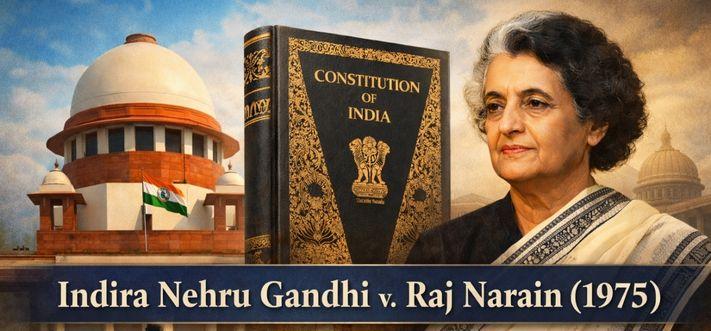
The case of Indira Nehru Gandhi v. Raj Narain (1975) is one of the most significant judgments in Indian constitutional history. It directly questioned the limits of political power, the supremacy of the Constitution, and the importance of the Rule of Law in a democratic system. The decision came at a critical moment in India’s political life and had far-reaching consequences, including the declaration of the National Emergency (1975–77).
This case established that no one, not even the Prime Minister of India, is above the law, reinforcing the democratic foundations of the Indian Constitution.
Background of the Case
1971 General Elections
In the 1971 Lok Sabha elections, Indira Gandhi, the then Prime Minister, contested from the Rae Bareli constituency in Uttar Pradesh. She defeated Raj Narain, a socialist leader and political opponent.
Raj Narain challenged her election by filing an election petition in the Allahabad High Court under the Representation of the People Act, 1951, alleging electoral malpractices.
Allegations Made by Raj Narain
Raj Narain accused Indira Gandhi of committing corrupt practices, including:
- Using government machinery for election campaigning
- Taking help of government officials
- Using state resources for personal election benefit
These actions were alleged to be violations of the Representation of the People Act, 1951.
Judgment of the Allahabad High Court (1975)
On 12 June 1975, Justice Jagmohan Lal Sinha of the Allahabad High Court delivered a historic judgment:
- Indira Gandhi was found guilty of electoral malpractices
- Her election was declared void
- She was disqualified from holding any elected office for six years
This judgment sent shockwaves across the nation and posed a direct challenge to the sitting Prime Minister’s authority.
Constitutional Amendment: 39th Amendment Act, 1975
In response to the judgment, the Parliament passed the 39th Constitutional Amendment Act, 1975, which:
- Inserted Article 329A into the Constitution
- Removed the power of courts to adjudicate election disputes of:
- President
- Vice-President
- Prime Minister
- Speaker of Lok Sabha
This amendment effectively placed the Prime Minister’s election beyond judicial review.
Appeal Before the Supreme Court
Indira Gandhi challenged the Allahabad High Court decision in the Supreme Court of India. At the same time, the constitutional validity of the 39th Amendment was also questioned.
Thus, the Supreme Court had to decide:
- Whether the 39th Amendment was constitutional
- Whether Parliament could place certain elections beyond judicial scrutiny
Issues Before the Supreme Court
The major constitutional issues were:
- Can Parliament amend the Constitution to validate an invalid election?
- Does excluding judicial review violate the Basic Structure of the Constitution?
- Is Rule of Law part of the Basic Structure?
Judgment of the Supreme Court (1975)
The Supreme Court delivered its judgment on 7 November 1975.
Key Findings
- Article 329A(4) was declared unconstitutional
- The Court held that excluding judicial review violated the Basic Structure Doctrine.
- Rule of Law is part of the Basic Structure
- No authority is above the law, including the Prime Minister.
- Free and Fair Elections are essential to democracy
- Democracy cannot survive without judicial oversight of elections.
- Separation of Powers must be maintained
- Parliament cannot exercise judicial functions.
Doctrine of Basic Structure Applied
The Court relied heavily on the Basic Structure Doctrine, established earlier in Kesavananda Bharati v. State of Kerala (1973).
The following were declared part of the Basic Structure:
- Rule of Law
- Democracy
- Judicial Review
- Equality before Law
- Free and Fair Elections
Any amendment violating these principles would be unconstitutional.
Opinion of Justice H.R. Khanna
Justice H.R. Khanna delivered a powerful opinion stating:
“Democracy is based on free and fair elections, and exclusion of judicial review strikes at the very heart of democracy.”
His opinion later became a cornerstone for constitutional interpretation in India.
Impact of the Judgment
1. Strengthening Rule of Law
The judgment reaffirmed that law is supreme, not political power.
2. Judicial Review Protected
Courts retained their authority to examine election disputes involving even the highest constitutional offices.
3. Check on Parliamentary Power
The case placed clear limits on Parliament’s power to amend the Constitution.
4. Democratic Values Upheld
It reinforced the idea that democracy cannot function without accountability.
Connection with National Emergency (1975)
Soon after the Allahabad High Court judgment, a National Emergency was declared under Article 352.
Though the Emergency was legally separate, this case is historically linked to it and highlighted the dangers of excessive concentration of power.
Significance for Law Students and Exams
This case is extremely important for:
- Constitutional Law
- Basic Structure Doctrine
- Judicial Review
- Rule of Law
- Election Laws
It is frequently asked in:
- LLB & BA-LLB exams
- UPSC GS-II
- Judiciary Exams
- UGC NET Law
Conclusion
Indira Nehru Gandhi v. Raj Narain (1975) stands as a powerful reminder that democracy survives only when power is limited by law. The Supreme Court’s decision ensured that constitutional supremacy, judicial review, and democratic values remain protected against political misuse.
The case cemented the principle that “No one is above the Constitution”, making it one of the most celebrated and influential judgments in Indian legal history.