
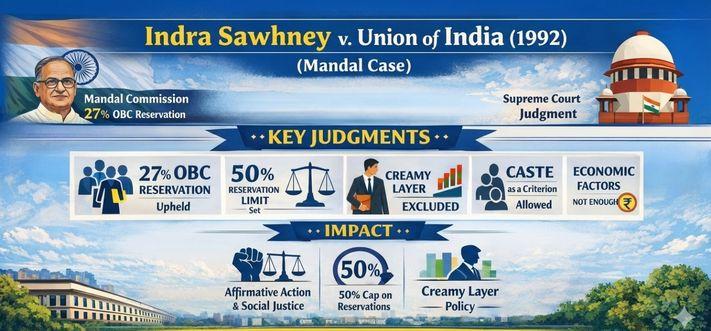
The judgment in Indra Sawhney v. Union of India (1992) is one of the most significant constitutional decisions in Indian legal history. Popularly known as the Mandal Case, it laid down authoritative principles governing reservation in public employment, especially for Other Backward Classes (OBCs). The Supreme Court not only upheld the constitutional validity of OBC reservation but also imposed crucial limitations to ensure equality, efficiency, and social justice.
This case continues to influence debates on affirmative action, equality, merit, and social justice in India.
Background of the Case
In 1979, the Second Backward Classes Commission, commonly known as the Mandal Commission, was constituted under Article 340 of the Constitution, with B.P. Mandal as its Chairman. The Commission identified Other Backward Classes (OBCs) and recommended 27% reservation in central government services and public sector undertakings.
In 1990, the Union Government issued an Office Memorandum implementing the Mandal Commission’s recommendations. This led to widespread protests and constitutional challenges, culminating in the landmark case of Indra Sawhney v. Union of India.
Issues Before the Supreme Court
The primary constitutional issues considered by the Court were:
- Whether caste can be the basis for identifying backward classes.
- Whether 27% reservation for OBCs in public employment is constitutional.
- Whether there is a limit on total reservation.
- Whether reservation can be extended to promotions.
- Whether economic criteria alone can define backwardness.
- Whether reservation should exclude the creamy layer among OBCs.
Judgment of the Court
The case was decided by a nine-judge constitutional bench with a 6:3 majority. The judgment upheld the Mandal Commission’s recommendations with important qualifications.
Key Principles Laid Down
1. Caste as a Criterion for Backwardness
The Court held that caste can be a relevant factor in identifying backward classes, especially in the Indian social context where caste-based discrimination has been historically entrenched. However, caste cannot be the sole criterion; social and educational backwardness must also be considered.
2. Constitutional Validity of 27% OBC Reservation
The Supreme Court upheld the 27% reservation for OBCs in public employment under Article 16(4) of the Constitution. It clarified that Article 16(4) is not an exception to equality but a facet of equality itself.
3. The 50% Reservation Ceiling
One of the most impactful rulings of the case was the fixation of a 50% ceiling on total reservation. The Court held that reservations should ordinarily not exceed 50%, as excessive reservation would undermine the principle of equality.
However, the Court allowed extraordinary circumstances (such as in remote or far-flung areas) where this limit may be relaxed.
4. Introduction of the Creamy Layer Doctrine
The Court introduced the Creamy Layer Principle, holding that socially advanced members of OBCs must be excluded from reservation benefits. The rationale was that reservation should benefit the truly backward, not the already privileged sections within backward classes.
This doctrine ensures that reservation remains a tool of social upliftment rather than political entitlement.
5. No Reservation in Promotions
The Court categorically ruled that reservation in promotion is unconstitutional for OBCs under Article 16(4). Reservation, according to the Court, is limited to initial appointments only.
(Reservation in promotion for SCs and STs was later addressed through constitutional amendments and subsequent judgments.)
6. Economic Criteria Alone Not Sufficient
The Court rejected the idea that economic backwardness alone can determine eligibility for reservation. It emphasized that poverty is a condition that can affect all classes and cannot be equated with social backwardness.
7. Backwardness Must Be Dynamic
The Court held that the list of backward classes cannot be permanent. It must be periodically reviewed to reflect changing social realities, ensuring that groups which have advanced are removed from the list.
Constitutional Provisions Interpreted
- Article 14 – Equality before law
- Article 15(4) – Special provisions for backward classes
- Article 16(1) – Equality of opportunity in public employment
- Article 16(4) – Reservation for backward classes
The judgment harmonized these provisions to balance equality and social justice.
Significance of the Judgment
1. Strengthened the Reservation Framework
Indra Sawhney gave constitutional legitimacy to OBC reservation while ensuring reasonable limits and safeguards.
2. Balanced Equality and Social Justice
By introducing the 50% cap and creamy layer exclusion, the Court ensured that equality of opportunity is not compromised.
3. Judicial Check on Executive Power
The judgment reaffirmed the role of the judiciary in reviewing reservation policies to prevent arbitrariness.
4. Long-Term Impact on Policy Making
Almost all subsequent reservation policies and judgments are influenced by the principles laid down in this case.
Criticism of the Judgment
Despite its significance, the judgment has faced criticism:
- The 50% cap is argued to be arbitrary in a society with deep inequality.
- Implementation of the creamy layer has been inconsistent.
- The ruling intensified political and social polarization around caste.
However, even critics acknowledge that the judgment brought constitutional discipline to reservation policies.
Conclusion
Indra Sawhney v. Union of India (1992) stands as a constitutional milestone that shaped India’s reservation jurisprudence. It upheld affirmative action as a means to achieve substantive equality, while simultaneously preventing its misuse through judicial safeguards.
The case reflects the Indian Constitution’s commitment to social justice, equality, and inclusiveness, making it indispensable for students, scholars, and policymakers alike.