
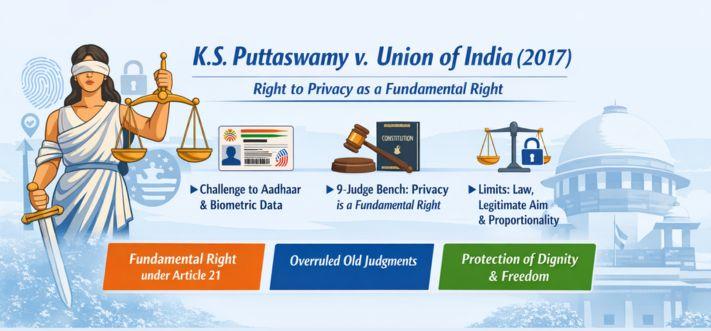
The judgment in K.S. Puttaswamy v. Union of India (2017) is one of the most significant constitutional decisions in Indian legal history. In this landmark case, a nine-judge bench of the Supreme Court of India unanimously held that the Right to Privacy is a Fundamental Right protected under the Indian Constitution.
This decision reshaped constitutional jurisprudence by strengthening individual liberty, dignity, and autonomy. It also laid the foundation for future rulings on data protection, surveillance, Aadhaar, and digital privacy in India.
Background of the Case
The case originated from concerns surrounding the Aadhaar biometric identification scheme, introduced by the Government of India. Aadhaar required citizens to provide biometric data such as fingerprints and iris scans to access welfare benefits and services.
Justice K.S. Puttaswamy (Retd.), a former High Court judge, filed a writ petition under Article 32 of the Constitution, challenging the constitutional validity of Aadhaar on the ground that it violated the Right to Privacy.
During the proceedings, the Union of India argued that privacy is not a fundamental right, relying on earlier Supreme Court judgments such as:
- M.P. Sharma v. Satish Chandra (1954)
- Kharak Singh v. State of Uttar Pradesh (1962)
Due to the importance of the issue, the matter was referred to a nine-judge constitutional bench to decide whether privacy is a fundamental right.
Issues Before the Court
The primary issue before the Supreme Court was:
Whether the Right to Privacy is a Fundamental Right under the Constitution of India?
Sub-issues included:
- Whether earlier judgments denying privacy as a fundamental right were correct.
- Whether privacy is protected under Article 21 (Right to Life and Personal Liberty) or other fundamental rights.
- The scope and limitations of the Right to Privacy.
Constitutional Provisions Involved
The Court examined the Right to Privacy in relation to:
- Article 14 – Right to Equality
- Article 19 – Freedoms such as speech, movement, and expression
- Article 21 – Right to Life and Personal Liberty
The Court emphasized that fundamental rights are not isolated provisions but form an interconnected framework protecting human dignity.
Judgment of the Supreme Court
On 24 August 2017, the nine-judge bench unanimously held that:
The Right to Privacy is a Fundamental Right intrinsic to life and personal liberty under Article 21 and part of the freedoms guaranteed by Part III of the Constitution.
The Court overruled the earlier decisions in M.P. Sharma and Kharak Singh to the extent that they denied privacy as a fundamental right.
Key Observations of the Court
1. Privacy is an Essential Aspect of Human Dignity
The Court held that privacy is deeply connected to human dignity, autonomy, and individuality. Without privacy, personal freedom becomes meaningless.
2. Privacy is Not Absolute
The Right to Privacy is subject to reasonable restrictions. Any invasion of privacy must satisfy:
- Legality – There must be a law.
- Legitimate Aim – The law must pursue a valid state objective.
- Proportionality – The intrusion must be necessary and minimal.
3. Privacy in the Digital Age
The Court acknowledged modern challenges such as:
- Data collection
- Surveillance
- Profiling
- Use of personal data by the State and private entities
This recognition made the judgment highly relevant in the era of technology and the internet.
4. International Influence
The Court referred to international human rights instruments and foreign judgments, emphasizing that privacy is recognized globally as a basic human right.
Impact on Aadhaar and Later Judgments
Although the Puttaswamy case did not directly strike down Aadhaar, it laid the constitutional foundation for later Aadhaar-related judgments.
In Justice K.S. Puttaswamy (Aadhaar) v. Union of India (2018), the Supreme Court upheld Aadhaar with restrictions, ensuring that privacy safeguards are maintained.
The 2017 privacy judgment also influenced later cases on:
- Phone tapping
- Surveillance
- Data protection
- Sexual orientation (Navtej Singh Johar v. Union of India, 2018)
Significance of the Judgment
1. Strengthening Fundamental Rights
The judgment expanded the interpretation of Article 21 and reinforced the idea that the Constitution is a living document.
2. Protection Against State Surveillance
It placed constitutional limits on unchecked state power, ensuring accountability and transparency.
3. Foundation for Data Protection Laws
The decision paved the way for India’s evolving data protection framework and privacy regulations.
4. Global Recognition
The judgment is frequently cited internationally for its progressive approach to privacy and human rights.
Criticism and Challenges
While widely praised, the judgment also raised challenges:
- Defining the exact scope of privacy in different contexts
- Balancing national security with individual liberty
- Effective enforcement of privacy rights in practice
Despite these challenges, the decision remains a milestone in constitutional law.
Conclusion
K.S. Puttaswamy v. Union of India (2017) stands as a constitutional landmark that reaffirmed the primacy of individual liberty in a democratic society. By declaring the Right to Privacy a Fundamental Right, the Supreme Court strengthened the protection of dignity, autonomy, and freedom in India.
In an age dominated by technology, data, and surveillance, this judgment serves as a powerful reminder that the Constitution protects not just the State, but the individual citizen.