
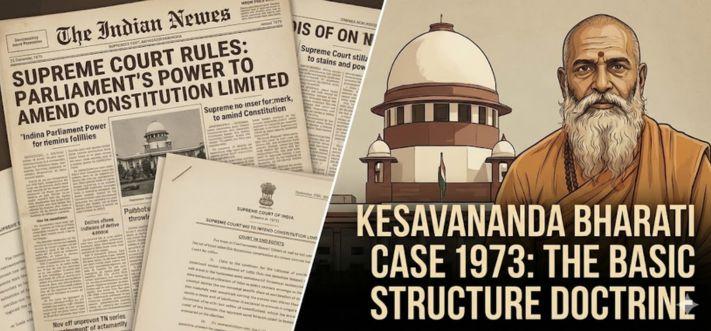
The Kesavananda Bharati v. State of Kerala (1973) case is one of the most important and historic judgments in Indian constitutional law. This landmark decision laid down the famous Basic Structure Doctrine, which acts as a safeguard against the misuse of Parliament’s power to amend the Constitution.
The Supreme Court held that while Parliament has the power to amend the Constitution under Article 368, it cannot alter or destroy the basic structure of the Constitution. This judgment has played a crucial role in protecting democracy, fundamental rights, and constitutional supremacy in India.
Who Was Kesavananda Bharati?
Kesavananda Bharati was the head (Chief Pontiff) of the Edneer Mutt, a Hindu religious institution located in Kerala. The Kerala government enacted land reform laws that placed restrictions on the management and ownership of land held by religious institutions.
Kesavananda Bharati challenged these laws, claiming that they violated his Fundamental Rights under Articles 25 and 26, which guarantee freedom of religion and the right to manage religious affairs.
Background of the Case
Before the Kesavananda Bharati case, there was a long-standing conflict between the Indian Parliament and the Judiciary regarding the extent of Parliament’s power to amend the Constitution.
Earlier Important Cases
- Shankari Prasad v. Union of India (1951) – Parliament could amend Fundamental Rights
- Sajjan Singh v. State of Rajasthan (1965) – Same view upheld
- Golaknath v. State of Punjab (1967) – Parliament could NOT amend Fundamental Rights
After the Golaknath judgment, the government amended Article 368, asserting that Parliament had unlimited power to amend any part of the Constitution, including Fundamental Rights. This led to the constitutional crisis that resulted in the Kesavananda Bharati case.
Issues Before the Supreme Court
The Supreme Court had to decide the following critical questions:
- Does Parliament have unlimited power to amend the Constitution under Article 368?
- Can Fundamental Rights be amended or taken away?
- Is there any inherent limitation on Parliament’s amending power?
- Does the Constitution have a “Basic Structure”?
Largest Constitutional Bench in Indian History
This case was heard by a 13-judge Constitution Bench, the largest bench ever constituted by the Supreme Court of India.
The judgment was delivered with a narrow majority of 7:6, reflecting the seriousness and complexity of the constitutional issues involved.
Judgment of the Supreme Court
Core Holding
Parliament has the power to amend the Constitution, including Fundamental Rights, but it cannot destroy or alter the Basic Structure of the Constitution.
This principle came to be known as the Basic Structure Doctrine.
What Is the Basic Structure Doctrine?
The Basic Structure Doctrine means that certain fundamental features of the Constitution are beyond the amending power of Parliament. These features form the core identity of the Constitution and cannot be removed or damaged.
Elements Considered Part of the Basic Structure
- Supremacy of the Constitution
- Rule of Law
- Separation of Powers
- Judicial Independence
- Federal Structure
- Secularism
- Democratic and Republican form of government
- Fundamental Rights
- Judicial Review
⚠️ Important Note:
The Supreme Court did not provide a fixed or exhaustive list. The meaning of “basic structure” evolves through judicial interpretation over time.
Interpretation of Article 368
The Court clarified that:
- Article 368 grants Parliament the power to amend the Constitution
- This power is not absolute or unlimited
- Any amendment that damages the Constitution’s basic structure is unconstitutional
Thus, constitutional amendments are subject to judicial review.
Arguments by the Government
The government argued that:
- Parliament represents the will of the people
- It should have unlimited power to amend the Constitution
- The concept of “basic structure” is not mentioned anywhere in the Constitution
Arguments by the Petitioner
Kesavananda Bharati argued that:
- The Constitution is not an ordinary law but a sacred social contract
- Unlimited amending power would lead to dictatorship
- Fundamental values of the Constitution must be protected
Significance of the Kesavananda Bharati Case
1. Protection of the Constitution
The judgment ensures that the Constitution cannot be destroyed by a temporary political majority.
2. Strengthening Judicial Review
The Supreme Court emerged as the guardian of the Constitution.
3. Preservation of Democracy
The ruling prevents authoritarian rule by limiting Parliament’s power.
4. Long-Term Impact
The Basic Structure Doctrine has been applied in several landmark cases:
- Indira Nehru Gandhi v. Raj Narain (1975)
- Minerva Mills v. Union of India (1980)
- S.R. Bommai v. Union of India (1994)
Importance for Law Students and Competitive Exams
- A core topic in Constitutional Law
- Frequently asked in LLB, Judiciary, UPSC, and UGC-NET exams
- Essential for case law analysis and answer writing
Conclusion
The Kesavananda Bharati Case (1973) is not just a legal judgment—it is the backbone of Indian constitutional democracy. By introducing the Basic Structure Doctrine, the Supreme Court ensured that the Constitution remains supreme, democratic, and resistant to misuse of power.
This decision continues to guide constitutional interpretation and safeguards the fundamental values upon which India stands.