
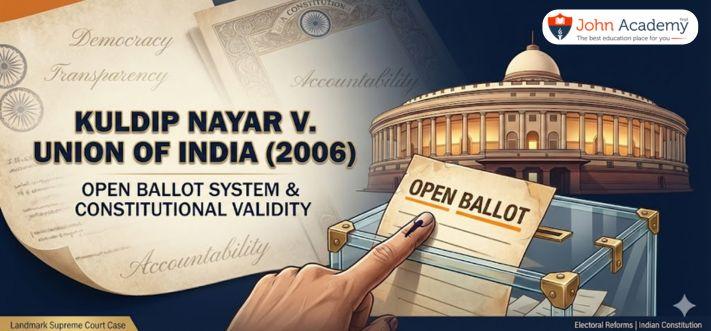
The Supreme Court judgment in Kuldip Nayar v. Union of India (2006) is a landmark constitutional case that examined the validity of the open ballot system in Rajya Sabha elections. The case addressed the delicate balance between secrecy of voting and curbing political corruption, especially in elections conducted through proportional representation by elected representatives.
This decision has lasting importance in Indian constitutional law, electoral reforms, and democratic accountability. With the introduction of new criminal law codes like the Bharatiya Nyaya Sanhita (BNS), 2023, the judgment also gains renewed relevance in discussions around electoral integrity and prevention of corrupt practices.
Background of the Case
Parties Involved
- Petitioner: Kuldip Nayar (journalist and public intellectual)
- Respondent: Union of India
Challenged Provisions
The petition challenged amendments made by the Representation of the People (Amendment) Act, 2003, which introduced:
- Open ballot system for Rajya Sabha elections
- Requirement for MLAs to show their ballot paper to an authorized party agent
The petitioner argued that these changes violated:
- Article 14 (Right to Equality)
- Article 19(1)(a) (Freedom of expression)
- Basic structure of the Constitution, particularly free and fair elections
Key Constitutional Issues
The Supreme Court examined the following issues:
- Is the secrecy of voting a fundamental right?
- Does the open ballot system violate democratic principles?
- Can Parliament regulate the manner of voting in indirect elections?
Arguments by the Petitioner
- Secrecy of vote is an essential feature of democracy
- Open ballot system exposes MLAs to party pressure and coercion
- The amendment destroys the independence of legislators
- It violates the basic structure doctrine
Arguments by the Union of India
- Rajya Sabha elections are indirect elections, not general elections
- Secrecy of vote is a statutory right, not a fundamental right
- Open ballot system prevents:
- Horse-trading
- Cross-voting
- Bribery and corruption
- Political parties have a legitimate interest in ensuring party discipline
Judgment of the Supreme Court
A 5-judge Constitution Bench upheld the validity of the amendment.
Key Findings
1. Secrecy of Voting is Not a Fundamental Right
The Court held that:
- Secrecy of vote is not a fundamental right
- It is a statutory privilege, which can be regulated by Parliament
2. Rajya Sabha Elections Are Different
- Rajya Sabha elections are conducted through proportional representation
- Voters are elected MLAs, not ordinary citizens
- Therefore, different voting procedures are constitutionally permissible
3. Open Ballot Does Not Violate Free and Fair Elections
- The Court ruled that the open ballot system:
- Enhances transparency
- Reduces corruption
- Strengthens democracy
4. No Violation of Basic Structure
- The amendment does not destroy democracy
- Instead, it protects the purity of the electoral process
Ratio Decidendi
“The concept of secrecy of voting is not an absolute principle and can be diluted in the larger interest of democracy.”
Link with Bharatiya Nyaya Sanhita (BNS), 2023
Although Kuldip Nayar v. Union of India is primarily a constitutional law case, its principles align closely with the objectives of the Bharatiya Nyaya Sanhita, 2023, particularly:
1. Electoral Integrity
The open ballot system helps prevent:
- Bribery
- Undue influence
- Corrupt practices
These objectives resonate with BNS provisions dealing with corruption, cheating, and abuse of public office, which aim to ensure clean governance and public trust.
2. Accountability of Public Representatives
Under BNS, public servants and elected representatives are subject to stricter scrutiny. The judgment supports the idea that transparency in public functions outweighs individual secrecy where public interest is involved.
3. Prevention over Punishment
While BNS provides punitive measures, the open ballot system acts as a preventive mechanism, reducing the scope for electoral crimes before they occur.
Significance of the Judgment
- Strengthened Electoral Reforms
- Curbed horse-trading in Rajya Sabha elections
- Clarified Scope of Voting Rights
- Distinguished between fundamental rights and statutory rights
- Reinforced Parliamentary Supremacy
- Recognized Parliament’s power to regulate election procedures
- Guidance for Future Reforms
- Influences debates on transparency vs. privacy in democratic systems
Critical Analysis
Positive Aspects
✔ Reduced corruption in indirect elections
✔ Enhanced party accountability
✔ Practical approach to Indian political realities
Criticism
✘ Risk of excessive party control over legislators
✘ Possible erosion of individual conscience voting
However, the Court preferred institutional integrity over individual secrecy in the specific context of Rajya Sabha elections.
Conclusion
Kuldip Nayar v. Union of India (2006) is a cornerstone judgment that redefined electoral transparency in India. By upholding the open ballot system, the Supreme Court prioritized clean politics, accountability, and democratic stability.
In the era of the Bharatiya Nyaya Sanhita, 2023, the judgment gains renewed importance as India moves towards preventing corruption rather than merely punishing it. The case remains highly relevant for students of constitutional law, political science, and competitive examinations.