
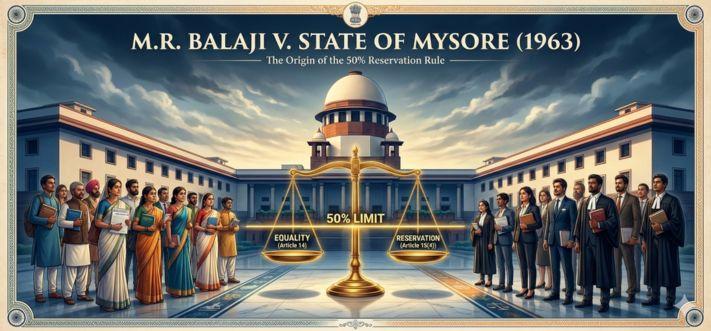
Reservation has always been one of the most debated constitutional policies in India. While it aims to ensure social justice and equality for historically disadvantaged groups, excessive reservation raises concerns about merit, fairness, and equality before law. One of the earliest and most significant Supreme Court judgments addressing this balance is M.R. Balaji v. State of Mysore (1963). This case laid down the 50% ceiling on reservation, which later became a foundational principle of Indian reservation jurisprudence.
The judgment clarified the meaning of “backward classes” under Article 15(4) of the Indian Constitution and emphasized that reservation is an exception, not the rule. Even decades later, this case remains relevant in constitutional law, administrative law, and equality jurisprudence, including its indirect relevance under the Bharatiya Nyaya Sanhita (BNS), 2023, which is founded on constitutional principles of fairness and non-arbitrariness.
Background of the Case
In 1962, the State of Mysore issued an order reserving 68% of seats in medical and engineering colleges for backward classes and Scheduled Castes and Scheduled Tribes. The classification included a large section of the population under the label of “backward classes.”
Several students, including M.R. Balaji, challenged this order before the Supreme Court. They argued that:
- The reservation percentage was excessive and unreasonable
- The classification of backward classes was vague and unscientific
- The order violated Article 15(1) (Right to Equality)
The State defended its action by relying on Article 15(4), which permits special provisions for socially and educationally backward classes.
Issues Before the Court
The Supreme Court considered the following key issues:
- What is the correct interpretation of Article 15(4)?
- Can caste alone determine “backwardness”?
- Is there any constitutional limit on the percentage of reservation?
- Whether 68% reservation violates the Right to Equality?
Judgment of the Supreme Court
The Supreme Court struck down the Mysore Government Order and delivered a landmark judgment with far-reaching consequences.
Key Principles Laid Down
1. Reservation Must Be Reasonable
The Court held that Article 15(4) is an enabling provision, not a fundamental right. It is an exception to the general principle of equality under Article 15(1).
Reservation should be used as a tool for advancement, not as a means to destroy equality.
2. 50% Reservation Limit
Although the Constitution does not explicitly prescribe a numerical limit, the Court observed that:
“Reservation should generally not exceed 50%.”
This observation became the first judicial articulation of the 50% rule, which was later firmly upheld in Indra Sawhney v. Union of India (1992).
The Court reasoned that excessive reservation would:
- Convert equality into inequality
- Exclude meritorious candidates unfairly
- Defeat the constitutional vision of balance
3. Caste Alone Cannot Determine Backwardness
The Court clarified that:
- Backwardness must be social and educational
- Caste may be a factor, but not the sole criterion
This principle discouraged blanket caste-based classification and required a scientific and rational assessment of backwardness.
4. Backward Classes ≠ Poor Classes
The Court rejected the argument that economic poverty alone defines backwardness. Instead, it emphasized:
- Historical discrimination
- Social disadvantage
- Educational deprivation
Constitutional Significance
The judgment strengthened the Right to Equality (Articles 14 and 15) by ensuring that affirmative action does not become arbitrary.
It reinforced three constitutional doctrines:
- Reasonable Classification
- Non-arbitrariness
- Balance between equality and social justice
Criticism of the Judgment
While widely respected, the judgment was criticized for:
- Not providing a clear constitutional formula for the 50% limit
- Leaving ambiguity about exceptional circumstances
- Being conservative in its approach to social justice
However, later cases refined and expanded these principles.
Relationship with Later Judgments
Indra Sawhney Case (1992)
The Supreme Court reaffirmed the 50% ceiling and clarified that exceeding it is permissible only in extraordinary circumstances.
M.R. Balaji as a Foundational Case
This case became the jurisprudential base for reservation law in India.
Relevance under Bharatiya Nyaya Sanhita (BNS), 2023
Although BNS primarily deals with substantive criminal law, its interpretation and application are deeply rooted in constitutional values such as equality, fairness, and reasonableness.
Indirect Constitutional Influence of M.R. Balaji on BNS
- Article 14 Compliance
Any classification under criminal law (including special procedures or protections) must satisfy the test of non-arbitrariness, a principle strengthened by M.R. Balaji. - Fairness in Penal Policy
BNS emphasizes proportionality and fairness in punishment. These principles echo the reasoning in M.R. Balaji, where the Court warned against excessive and disproportionate measures. - Reasonable Classification in Criminal Justice
Special provisions under BNS (e.g., for women, children, or vulnerable groups) must be reasonable and constitutionally valid, just like reservation policies.
Thus, while M.R. Balaji is not a criminal law case, its constitutional philosophy indirectly governs the application of BNS.
Present-Day Relevance
Even today, debates on:
- Expansion of reservation
- EWS quota
- State-specific reservation policies
are tested against the 50% rule, originally articulated in M.R. Balaji.
The case reminds policymakers that:
Social justice must operate within constitutional discipline.
Conclusion
M.R. Balaji v. State of Mysore (1963) is a cornerstone of Indian constitutional law. It introduced the principle that reservation must be limited, reasonable, and justified. The judgment preserved the delicate balance between affirmative action and equality, ensuring that social justice does not override constitutional fairness.
Its influence extends beyond reservation law into broader constitutional governance, including the interpretation of modern legislations like the Bharatiya Nyaya Sanhita, 2023, which must function within the same framework of equality, proportionality, and reasonableness.
In essence, M.R. Balaji is not just a reservation case—it is a constitutional compass guiding India’s commitment to both justice and equality.