
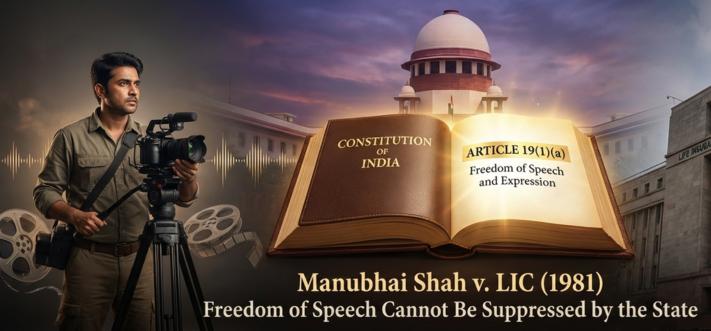
Freedom of Speech and Expression under Article 19(1)(a) of the Indian Constitution is one of the most cherished fundamental rights. It is the foundation of a democratic society, enabling citizens to express opinions, criticize authority, and participate meaningfully in public discourse. Over the years, the Supreme Court of India has expanded the scope of this right through progressive interpretations.
One such landmark judgment is Manubhai Shah v. Life Insurance Corporation of India (1981). This case is significant because it examined whether a public sector undertaking (PSU) like LIC could restrict the expression of critical views merely because such views were inconvenient or uncomfortable. The judgment strongly reaffirmed that state-controlled bodies cannot suppress free expression arbitrarily.
Background of the Case
- Manubhai Shah was a journalist, writer, and social activist.
- He produced a documentary film critically examining the policies and functioning of the Life Insurance Corporation of India (LIC).
- The documentary was intended to generate public awareness and debate on issues related to LIC’s operations.
- Manubhai Shah sought permission to screen the film at an auditorium owned and controlled by LIC.
LIC refused permission, arguing that:
- The film portrayed the organization in a negative light,
- It could damage the reputation and credibility of LIC, and
- As the owner of the auditorium, LIC had discretion over its use.
Aggrieved by this refusal, Manubhai Shah approached the Supreme Court, claiming violation of his Fundamental Right to Freedom of Speech and Expression under Article 19(1)(a).
Issues Before the Court
The Supreme Court considered the following key issues:
- Whether LIC qualifies as “State” under Article 12 of the Constitution.
- Whether screening a documentary film falls within the ambit of Freedom of Speech and Expression.
- Whether refusal by LIC amounted to an unconstitutional restriction on free speech.
- Whether a public authority can suppress criticism simply because it is unfavorable.
Judgment of the Supreme Court
The Supreme Court ruled in favour of Manubhai Shah, holding that LIC’s refusal was unconstitutional and violative of Article 19(1)(a).
Key Legal Principles Laid Down
1. LIC is “State” under Article 12
The Court held that:
- LIC is a statutory corporation,
- It is created by an Act of Parliament,
- It is financially and administratively controlled by the government.
Therefore, LIC falls within the definition of “State” under Article 12 and is bound to respect Fundamental Rights.
2. Documentary Films are Protected Speech
The Court clarified that:
- Freedom of Speech and Expression is not confined to spoken or written words,
- It includes films, documentaries, art, and other visual media.
Thus, a documentary film expressing critical views is fully protected under Article 19(1)(a).
3. Right to Criticize Public Institutions
The Supreme Court emphasized that:
- Criticism of public authorities is an essential feature of democracy,
- A government-controlled body cannot deny access to public facilities merely because the views expressed are critical.
The Court observed that democracy thrives on debate, dissent, and criticism, and suppressing such voices weakens democratic governance.
4. Limits of Reasonable Restrictions (Article 19(2))
The Court examined whether LIC’s refusal could be justified under Article 19(2), which permits reasonable restrictions on free speech in the interest of:
- Sovereignty and integrity of India,
- Security of the State,
- Public order,
- Decency or morality,
- Defamation, etc.
The Court held that:
- LIC’s justification of protecting its “image” does not fall under any permissible ground of Article 19(2).
- Mere apprehension of criticism or embarrassment is not a valid constitutional ground for restricting free speech.
Significance of the Judgment
1. Strengthening Freedom of Speech
This case broadened the understanding of Article 19(1)(a) by ensuring that:
- Freedom of speech includes the right to access public platforms controlled by the State, subject to reasonable conditions.
2. Accountability of Public Sector Undertakings
The judgment made it clear that:
- PSUs cannot behave like private entities when exercising control over public resources.
- They must act fairly, non-arbitrarily, and constitutionally.
3. Protection to Media and Filmmakers
The ruling provided:
- Strong protection to journalists, filmmakers, and social critics,
- Encouragement for investigative journalism and public-interest documentaries.
4. Reinforcing Democratic Values
The Court famously underscored that:
“Freedom of speech is the lifeline of democracy.”
Without the freedom to criticize public institutions, democracy becomes hollow and authoritarian.
Related Case Laws
- Bennett Coleman & Co. v. Union of India (1973) – Freedom of the Press
- Indian Express Newspapers v. Union of India (1985) – Media independence
- S. Rangarajan v. P. Jagjivan Ram (1989) – Limits on film censorship
- Shreya Singhal v. Union of India (2015) – Online freedom of expression
Manubhai Shah v. LIC forms an important link in this constitutional chain protecting free expression.
Conclusion
Manubhai Shah v. Life Insurance Corporation of India (1981) stands as a landmark judgment that reaffirmed the constitutional commitment to free speech. The Supreme Court made it clear that:
- State-controlled institutions cannot suppress criticism,
- Freedom of Speech includes the right to express dissenting and unpopular views, and
- Public authorities must tolerate scrutiny in a democracy.
In an era where freedom of expression often faces subtle and indirect restrictions, this judgment remains deeply relevant. It reminds us that disagreement is not disloyalty, and criticism is not hostility, but rather the essence of democratic governance.