
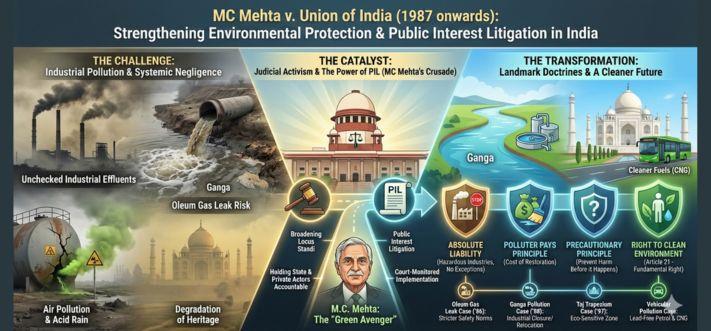
The case of MC Mehta v. Union of India (1987 onwards) is one of the most significant and influential judgments in Indian legal history. It is not a single case but a series of landmark environmental litigations filed by environmental lawyer M.C. Mehta, which transformed India’s approach to environmental protection, sustainable development, and Public Interest Litigation (PIL).
Through these cases, the Supreme Court of India expanded Article 21 of the Constitution, introduced critical environmental doctrines, and ensured that industrial and governmental activities do not come at the cost of public health and ecological balance. The MC Mehta cases firmly established the judiciary as the guardian of the environment in India.
Background of the Case
During the 1980s, India was witnessing rapid industrialization, often at the expense of environmental safety. Pollution of air, water, and soil had reached alarming levels, especially in urban and industrial regions.
M.C. Mehta, a public-spirited lawyer, approached the Supreme Court under Article 32 of the Constitution to seek enforcement of fundamental rights, particularly the right to life under Article 21, which he argued included the right to a clean and healthy environment.
The first major case in this series arose from the Oleum Gas Leak from Shriram Food and Fertilizer Industries in Delhi (1985), leading to the landmark 1987 judgment.
Key Issues Before the Court
The Supreme Court examined several crucial questions:
- Whether the right to life under Article 21 includes the right to a pollution-free environment.
- Whether industries engaged in hazardous activities should be held absolutely liable for environmental harm.
- Whether Public Interest Litigation (PIL) can be used to protect environmental and public health interests.
- What role the judiciary should play in enforcing environmental laws.
Doctrine of Absolute Liability
One of the most important contributions of MC Mehta v. Union of India (1987) is the development of the Doctrine of Absolute Liability.
Absolute Liability Explained
The Court held that:
- Any enterprise engaged in hazardous or inherently dangerous activities is absolutely liable for the harm caused.
- Such liability exists without any exceptions, unlike the English doctrine of strict liability (Rylands v. Fletcher).
This principle was evolved considering India’s socio-economic conditions, where poor and vulnerable communities are most affected by industrial disasters.
Significance
- Industries cannot escape liability by claiming absence of negligence.
- The doctrine strengthened corporate accountability.
- It became a foundation for modern environmental jurisprudence in India.
Expansion of Article 21: Right to a Healthy Environment
In MC Mehta cases, the Supreme Court consistently ruled that:
“The right to life under Article 21 includes the right to live in a clean, healthy, and pollution-free environment.”
This interpretation gave constitutional status to environmental protection and allowed citizens to directly approach courts for environmental violations.
Strengthening Public Interest Litigation (PIL)
Before MC Mehta cases, access to justice was largely limited to aggrieved individuals. These cases expanded the scope of Public Interest Litigation, allowing:
- Any public-spirited individual to file petitions on behalf of affected communities.
- Relaxation of the locus standi rule.
- Use of letters, reports, and newspaper articles as valid PIL petitions.
Environmental PIL became a powerful tool for:
- Protecting forests and rivers
- Regulating industries
- Ensuring governmental accountability
Major MC Mehta Environmental Cases
1. Oleum Gas Leak Case (1987)
- Laid down the Doctrine of Absolute Liability.
- Ordered compensation to victims.
- Directed industries to follow strict safety standards.
2. Ganga Pollution Case
- Ordered closure or relocation of polluting tanneries.
- Held that economic development cannot override environmental protection.
- Emphasized the Polluter Pays Principle.
3. Taj Trapezium Case
- Protected the Taj Mahal from industrial pollution.
- Ordered industries to shift to cleaner fuel.
- Recognized the importance of protecting cultural heritage.
4. Vehicular Pollution Case (Delhi)
- Directed introduction of CNG vehicles.
- Improved air quality in Delhi.
- Demonstrated proactive judicial intervention.
Environmental Principles Developed
Through MC Mehta cases, the Supreme Court adopted and developed key environmental principles:
- Polluter Pays Principle
- Precautionary Principle
- Sustainable Development
- Public Trust Doctrine
These principles are now integral to Indian environmental law and are frequently cited in later judgments.
Judicial Activism and Criticism
While MC Mehta cases are widely praised, they have also faced criticism:
Criticism
- Allegations of judicial overreach
- Courts entering the domain of the executive
- Economic impact on industries
Justification
The Court justified its activism by stating that:
- When executive agencies fail, the judiciary must intervene.
- Environmental damage is often irreversible.
- Fundamental rights demand immediate protection.
Impact and Significance
The MC Mehta judgments have had a long-lasting impact:
- Strengthened environmental governance in India
- Inspired enactment and enforcement of environmental laws
- Empowered citizens through PIL
- Made industries more accountable
- Influenced international environmental jurisprudence
These cases converted environmental protection from a policy issue into a constitutional obligation.
Conclusion
MC Mehta v. Union of India (1987 onwards) stands as a cornerstone of Indian environmental law. By expanding Article 21, introducing absolute liability, and strengthening Public Interest Litigation, the Supreme Court ensured that environmental protection became an inseparable part of the right to life.
The case series highlights the judiciary’s crucial role in balancing development, public health, and ecological sustainability. Even decades later, MC Mehta cases continue to guide courts, policymakers, and environmental activists across India.