
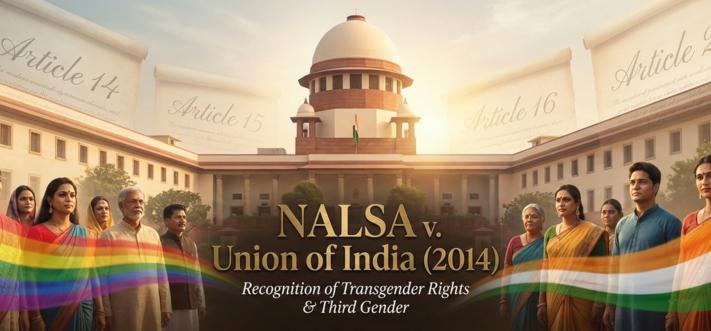
The Supreme Court of India’s decision in National Legal Services Authority (NALSA) v. Union of India (2014) stands as a watershed moment in the constitutional and human rights jurisprudence of India. For the first time, the Court explicitly recognized transgender persons as a “third gender” and affirmed that they are entitled to the full spectrum of fundamental rights guaranteed under the Constitution of India. This judgment not only addressed long-standing social exclusion and discrimination but also redefined equality, dignity, and personal liberty under Indian constitutional law.
Background of the Case
The petition was filed by the National Legal Services Authority (NALSA) along with several transgender activists seeking legal recognition and protection of the rights of transgender persons. Historically, transgender communities—such as Hijras, Eunuchs, Aravanis, and others—had faced systemic discrimination, social ostracization, denial of education, healthcare, employment, and legal identity.
Despite their presence in Indian society for centuries, there was no clear legal framework recognizing their gender identity. Official documents such as birth certificates, passports, voter IDs, and educational records forced individuals to identify only as “male” or “female,” denying transgender persons their lived reality and dignity.
Issues Before the Court
The Supreme Court examined several critical constitutional questions:
- Whether transgender persons have the right to legal recognition of their gender identity.
- Whether denial of such recognition violates Articles 14, 15, 16, 19, and 21 of the Constitution.
- Whether self-identified gender identity should be recognized without medical or surgical requirements.
- What obligations the State has to ensure social and economic justice for transgender persons.
Judgment and Key Findings
In a progressive and rights-oriented judgment delivered by Justice K.S. Radhakrishnan and Justice A.K. Sikri, the Supreme Court ruled decisively in favor of transgender rights.
1. Recognition of Third Gender
The Court held that transgender persons must be recognized as a “third gender” for the purposes of safeguarding their rights under the Constitution and laws. This recognition was not limited to Hijras alone but extended to all persons whose gender identity does not conform to the binary understanding of male and female.
2. Right to Self-Identified Gender
One of the most revolutionary aspects of the judgment was the affirmation that gender identity is integral to personal autonomy and dignity. The Court ruled that a person’s self-identified gender must be legally recognized without compulsory medical procedures, such as sex reassignment surgery.
This principle firmly rejected the notion that biological or medical criteria alone determine gender, aligning Indian jurisprudence with international human rights standards.
Constitutional Provisions Applied
The Court extensively interpreted multiple constitutional provisions:
- Article 14 (Right to Equality): The term “person” includes transgender persons; therefore, denying them equal protection of the law is unconstitutional.
- Articles 15 and 16 (Non-Discrimination): Discrimination on the ground of “sex” includes discrimination based on gender identity.
- Article 19 (Freedom of Expression): Gender expression, including clothing and appearance, is protected.
- Article 21 (Right to Life and Personal Liberty): The right to live with dignity includes the right to choose one’s gender identity.
The Court emphasized that constitutional morality must prevail over social morality.
International Law and Comparative Jurisprudence
The judgment drew support from international human rights instruments and foreign jurisprudence, including:
- Universal Declaration of Human Rights (UDHR)
- International Covenant on Civil and Political Rights (ICCPR)
- Yogyakarta Principles on Sexual Orientation and Gender Identity
The Court recognized that India, as a signatory to international conventions, has an obligation to respect and protect the rights of transgender persons.
Directions Issued by the Supreme Court
The Court issued comprehensive directions to the Central and State Governments, including:
- Legal recognition of transgender persons as third gender.
- Permission to identify as male, female, or third gender.
- Inclusion of transgender persons in Socially and Educationally Backward Classes (SEBCs) for reservation in education and public employment.
- Formulation of welfare schemes for healthcare, education, and employment.
- Establishment of HIV surveillance centers and access to public healthcare.
- Public awareness campaigns to reduce stigma and discrimination.
Significance of the Judgment
The NALSA judgment fundamentally transformed Indian constitutional law by expanding the meaning of equality and dignity. Its importance lies in:
- Shifting from binary gender norms to a rights-based understanding of gender identity.
- Recognizing self-determination as central to personal liberty.
- Laying the foundation for future legislative and judicial developments, including the Transgender Persons (Protection of Rights) Act, 2019.
- Influencing later judgments such as Puttaswamy v. Union of India (2017) and Navtej Singh Johar v. Union of India (2018).
Criticism and Challenges
Despite its progressive nature, implementation of the judgment has faced challenges:
- Delays and inconsistencies in policy formulation by States.
- The 2019 Transgender Act was criticized for diluting the principle of self-identification by introducing certification procedures.
- Continued social stigma and lack of access to education and employment remain pressing issues.
Nonetheless, the judgment remains a constitutional beacon guiding future reforms.
Conclusion
NALSA v. Union of India (2014) is a landmark judgment that reaffirmed the Constitution’s promise of equality, dignity, and freedom for all persons, regardless of gender identity. By recognizing transgender persons as equal citizens and affirming their right to self-identified gender, the Supreme Court reshaped Indian human rights jurisprudence.
The decision underscores that democracy thrives not merely on majority will, but on the protection of minorities and marginalized communities. NALSA is not just a legal victory—it is a moral and constitutional affirmation that every individual has the right to live with dignity and self-respect.