
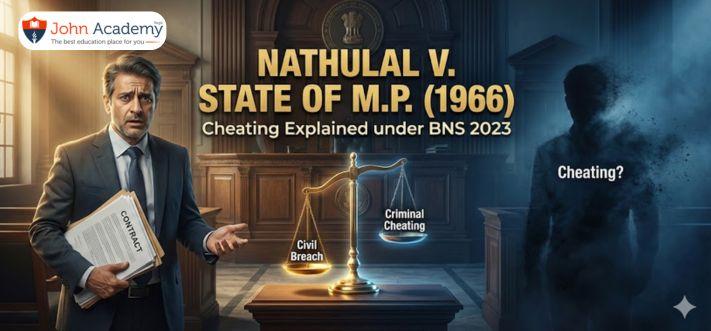
The landmark judgment in Nathulal v. State of M.P. (1966) is a classic authority on the essential ingredients of the offence of cheating and the distinction between breach of contract and criminal liability. The Supreme Court of India, through this decision, clarified that mere failure to perform a contractual obligation does not automatically amount to cheating unless dishonest intention exists at the very inception of the transaction.
Even today, this case holds immense relevance, especially under the Bharatiya Nyaya Sanhita, 2023 (BNS), which replaces the Indian Penal Code, 1860. The principles laid down in this judgment continue to guide courts in preventing the misuse of criminal law in civil disputes.
Facts of the Case
- Nathulal entered into a contract with the complainant for the supply of food grains.
- The complainant paid an advance amount.
- Due to the absence of a valid licence/permit, Nathulal could not supply the goods within the stipulated time.
- A criminal complaint was filed alleging cheating under Section 420 IPC.
- Nathulal contended that:
- He never had dishonest intention.
- Failure occurred due to legal and administrative constraints.
- At best, it was a civil breach of contract, not a criminal offence.
The matter ultimately reached the Supreme Court of India.
Legal Issue Involved
Whether failure to perform a promise or contract, without dishonest intention at the inception, constitutes the offence of cheating?
Judgment of the Supreme Court
The Supreme Court acquitted Nathulal and held that:
- Dishonest intention must exist at the time of making the promise.
- If the intention was honest initially and the promise could not be fulfilled later due to circumstances beyond control, no offence of cheating is made out.
- Criminal law cannot be used as a tool to pressure or punish parties in purely civil disputes.
Ratio Decidendi
For the offence of cheating, the dishonest intention must exist at the very inception of the transaction. A subsequent failure to perform a promise does not amount to cheating.
Cheating under IPC vs BNS
Under IPC, 1860
- Section 415 – Definition of cheating
- Section 420 – Cheating and dishonestly inducing delivery of property
Under BNS, 2023
- Section 316 BNS – Definition of cheating
- Section 318 BNS – Cheating and dishonestly inducing delivery of property
The language under BNS largely retains the substantive principles of IPC, making the Nathulal judgment fully applicable even after the criminal law reform.
Essential Ingredients of Cheating (as reaffirmed in Nathulal Case)
To constitute cheating under Section 316 & 318 BNS, the following must be established:
- Deception of a person
- Fraudulent or dishonest inducement
- Delivery of property or consent
- Dishonest intention at the inception
If any of these elements is missing, criminal liability does not arise.
Civil Breach of Contract vs Criminal Cheating
The Nathulal case draws a clear boundary between civil and criminal liability:
|
Civil Breach |
Criminal Cheating |
|---|---|
|
Failure due to circumstances |
Intentional deception |
|
Remedy in civil court |
Punishable under BNS |
|
No mens rea |
Dishonest intention from beginning |
This distinction is vital to prevent criminalisation of commercial disputes.
Relevance under Bharatiya Nyaya Sanhita, 2023
With the enforcement of BNS:
- Courts continue to rely on judicial precedents to interpret mens rea.
- Nathulal’s case acts as a safeguard against misuse of Sections 316–318 BNS.
- It ensures that business failures, regulatory delays, or licensing issues are not wrongly converted into criminal cases.
Importance for Law Students & Judiciary Aspirants
This case is frequently cited in:
- LL.B examinations
- Judicial Services (PCS-J)
- UPSC Law Optional
- Criminal Law problem questions
Examiners often ask:
“When does breach of contract amount to cheating?”
Nathulal v. State of M.P. is the standard answer.
Later Cases Following Nathulal Principle
Several later judgments reaffirmed this doctrine:
- Hridaya Ranjan Prasad Verma v. State of Bihar
- V.Y. Jose v. State of Gujarat
- Dalip Kaur v. Jagnar Singh
All reiterate that criminal intention must precede or accompany the inducement.
Critical Analysis
Strengths
- Protects individuals from harassment through criminal law
- Maintains sanctity of civil remedies
- Promotes fairness in commercial dealings
Limitations
- Requires courts to carefully infer intention, which can be subjective
- Risk of genuine fraud being disguised as civil breach
Despite these limitations, the judgment strikes a balanced approach.
Conclusion
Nathulal v. State of Madhya Pradesh (1966) remains a cornerstone of Indian criminal jurisprudence. Its principles seamlessly transition into the Bharatiya Nyaya Sanhita, 2023, reinforcing that criminal law is not a substitute for civil remedies.
By insisting on dishonest intention at the inception, the Supreme Court ensured that justice is rooted in mens rea, not mere non-performance. This case continues to guide courts, lawyers, and students in interpreting the offence of cheating with clarity and restraint.