
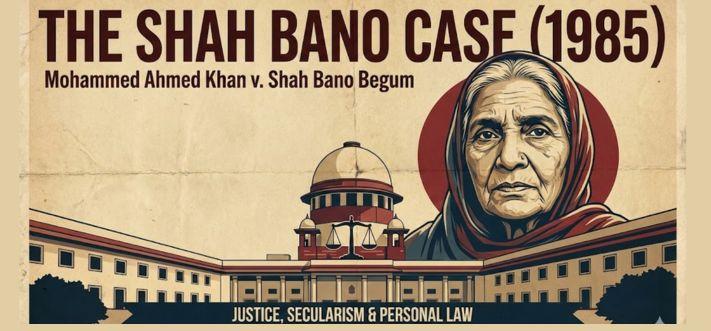
The Shah Bano case, formally known as Mohammed Ahmed Khan v. Shah Bano Begum (1985), remains one of the most significant and widely discussed landmark judgments in India’s legal and socio-political history. It not only shaped the discourse on women’s rights but also tested the balance between religious personal laws and the constitutional mandate of equality. This case continues to resonate in discussions on gender justice, secularism, and legislative intervention in India.
Background of the Case
Shah Bano Begum, a 62-year-old Muslim woman from Indore, was married to Mohammed Ahmed Khan in 1932. The couple had five children together. After several decades of marriage, Mohammed Ahmed Khan divorced Shah Bano in 1978 using the practice of triple talaq, which allowed a Muslim man to unilaterally divorce his wife by pronouncing "talaq" three times. Shah Bano, left without support, filed a case in the Madhya Pradesh High Court seeking maintenance under Section 125 of the Code of Criminal Procedure (CrPC), which mandates that a husband must provide financial support to his wife if she is unable to maintain herself.
The case was escalated to the Supreme Court of India in 1985 due to its unprecedented nature and far-reaching implications.
Key Legal Questions
The Shah Bano case raised several critical legal and constitutional questions:
- Whether Section 125 of the CrPC applied to Muslim women who had been divorced under personal law?
- Does a divorced Muslim woman have the right to maintenance beyond the iddat period under Islamic law?
- How should personal laws interact with constitutional principles of equality (Article 14) and protection of life and dignity (Article 21)?
The case highlighted the tension between religious personal laws and the fundamental rights guaranteed by the Constitution.
Supreme Court Judgment
On 23 April 1985, the Supreme Court, in a majority decision, ruled in favor of Shah Bano. The key points of the judgment were:
- Maintenance Beyond Iddat Period:
The Court held that a Muslim woman could claim maintenance from her husband under Section 125 of CrPC, even after the iddat period. The iddat period, traditionally mandated by Islamic law, was usually three months. The Court asserted that Section 125 was a secular provision designed to prevent destitution of wives and dependents. - Secular Application of Law:
The Court emphasized that CrPC provisions override personal laws when it comes to the protection of life and dignity. It ruled that personal laws cannot be used to deny a woman her right to maintenance, especially when she has no means of support. - Equality and Justice:
The Court interpreted Articles 14, 15, and 21 of the Indian Constitution to ensure justice for women. It declared that denying maintenance to Shah Bano would be unjust, discriminatory, and unconstitutional. - Responsibility of State:
The Court also noted the duty of the State to protect women from destitution, emphasizing that secular law should serve as a safety net in cases where personal laws fail to protect women.
The Supreme Court awarded Shah Bano maintenance of Rs. 500 per month from her husband.
Reaction to the Judgment
The Shah Bano judgment sparked intense political, social, and religious debates:
- Conservative Opposition:
Many Muslim clerics and organizations opposed the ruling, claiming it interfered with Muslim personal law. They argued that Islamic law governed marriage and divorce, and the Court’s intervention violated religious freedom. - Political Backlash:
The government of Rajiv Gandhi, fearing political fallout among the Muslim community, passed the Muslim Women (Protection of Rights on Divorce) Act, 1986. This Act effectively overruled the Supreme Court’s decision, limiting a divorced Muslim woman’s maintenance to the iddat period, with the provision that her relatives or the Waqf Board could assist her thereafter. - Public Debate:
The case ignited nationwide debates on gender justice, secularism, and uniform civil code. While Shah Bano’s supporters saw it as a victory for women’s rights, critics viewed the judgment as judicial overreach into religious matters.
Significance of the Shah Bano Case
The Shah Bano case is considered a milestone in Indian legal history for several reasons:
- Women’s Rights:
- The case highlighted the vulnerability of divorced women under personal laws.
- It emphasized the constitutional right to maintenance and dignity for women, irrespective of religion.
- Secularism vs. Religious Personal Laws:
- The judgment underscored the tension between secular law and religious law.
- It reinforced the idea that constitutional principles take precedence over discriminatory practices in personal laws.
- Judicial Activism:
- The case marked a significant example of judicial activism in India, where the Court stepped in to protect marginalized citizens.
- Legislative Intervention:
- The Muslim Women (Protection of Rights on Divorce) Act, 1986 showed how political considerations could influence legislation, raising questions about the protection of women’s rights versus appeasement politics.
- Catalyst for Reform:
- Shah Bano’s case became a reference point in discussions about a Uniform Civil Code (Article 44 of the Constitution), highlighting the need to harmonize personal laws with constitutional values of equality and justice.
Criticism and Legacy
While the judgment is praised for upholding women’s rights, it faced criticism:
- Some argued that the Supreme Court ignored religious sentiments and overstepped judicial boundaries.
- Others felt the subsequent 1986 Act diluted women’s rights, making the judgment symbolic but not fully effective in practice.
Despite these criticisms, the Shah Bano case remains iconic in legal education, social reforms, and gender justice debates. It is frequently cited in PILs, women’s rights cases, and discussions about personal law reforms in India.
Conclusion
The Shah Bano case represents a turning point in India’s legal and social history. It brought national attention to the plight of divorced Muslim women and emphasized that constitutional morality and justice cannot be compromised for religious traditions that perpetuate inequality. While the case led to political controversy and legislative intervention, it remains a symbol of the struggle for women’s rights in India.
Even today, Shah Bano’s story inspires legal scholars, feminists, and policymakers to pursue gender equality, secular justice, and social reform. It serves as a reminder that justice must be accessible to every citizen, regardless of religion, gender, or social status.