
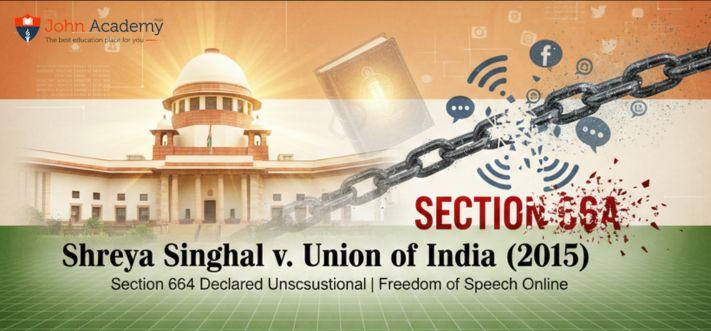
The Supreme Court judgment in Shreya Singhal v. Union of India (2015) is one of the most celebrated decisions in Indian constitutional history concerning freedom of speech and expression under Article 19(1)(a). Delivered in the backdrop of rising internet usage and digital expression, the case addressed the constitutionality of Section 66A of the Information Technology Act, 2000, a provision widely misused to curb online speech.
The judgment not only struck down Section 66A as unconstitutional, but also laid down important principles regarding vagueness of law, chilling effect on speech, and reasonable restrictions, principles that remain relevant even after the enactment of the Bharatiya Nyaya Sanhita (BNS), 2023.
Background of the Case
Section 66A of the IT Act criminalised sending through electronic communication any information that was:
- Grossly offensive
- Menacing in character
- Causing annoyance, inconvenience, danger, insult, injury, criminal intimidation, enmity, hatred or ill will
The punishment prescribed was imprisonment up to three years and fine.
The provision became controversial due to arbitrary arrests, especially of students, journalists, and ordinary citizens for social media posts and comments. A notable incident involved the arrest of two young women in Maharashtra for merely criticising a bandh on Facebook.
Shreya Singhal, a law student, filed a Public Interest Litigation (PIL) under Article 32, challenging the constitutional validity of Section 66A.
Issues Before the Court
The Supreme Court considered the following key issues:
- Whether Section 66A violates Article 19(1)(a) (Freedom of Speech and Expression)?
- Whether the restrictions under Section 66A can be justified under Article 19(2)?
- Whether the provision is vague, arbitrary, and disproportionate?
- Whether Section 66A creates a chilling effect on free speech?
Arguments by the Petitioners
The petitioners argued that:
- Section 66A uses undefined and vague expressions such as “annoyance” and “grossly offensive”.
- The provision gives unguided discretion to police authorities, leading to misuse.
- Legitimate dissent, criticism, satire, and political speech are suppressed.
- The fear of arrest discourages people from expressing opinions online, resulting in a chilling effect.
Arguments by the Union of India
The government contended that:
- The internet has a wider reach and faster dissemination than traditional media.
- Section 66A is necessary to maintain public order and prevent misuse of online platforms.
- Safeguards exist through procedural requirements and judicial review.
Judgment of the Supreme Court
A two-judge bench of Justice J. Chelameswar and Justice Rohinton F. Nariman delivered a landmark judgment.
Section 66A Declared Unconstitutional
The Court struck down Section 66A in its entirety, holding that it violates Article 19(1)(a) and is not protected by Article 19(2).
Key Legal Reasoning
1. Vagueness of Law
The Court held that Section 66A suffers from constitutional vagueness. Words like annoyance, inconvenience, and grossly offensive have no clear legal definition, making it impossible for citizens to know what conduct is criminal.
A vague law:
- Violates Article 14 (Equality before law)
- Leads to arbitrary enforcement
2. Chilling Effect on Free Speech
The Court emphasized the doctrine of chilling effect, stating that when people are uncertain about the legality of their speech, they tend to self-censor, which is more dangerous than direct censorship.
Freedom of speech includes:
- Political dissent
- Criticism of government
- Unpopular or minority opinions
3. Article 19(2): Narrow Interpretation
The Court reiterated that restrictions on free speech must fall strictly within the grounds mentioned in Article 19(2) such as:
- Public order
- Defamation
- Incitement to an offence
Section 66A went far beyond these grounds and criminalised speech merely causing annoyance, which is not a valid constitutional ground.
4. Discussion on Sections 69A and 79
- Section 69A (blocking of websites) was upheld because it contains procedural safeguards.
- Section 79 (intermediary liability) was read down to protect online platforms unless there is actual knowledge of unlawful content.
Significance of the Judgment
The Shreya Singhal case is significant because:
- It recognised the internet as a vital platform for democratic discourse.
- It protected online speech at par with offline speech.
- It limited state power over digital expression.
- It strengthened judicial scrutiny over vague penal provisions.
Shreya Singhal Case and Bharatiya Nyaya Sanhita (BNS), 2023
With the repeal of the Indian Penal Code, 1860, and its replacement by the BNS, 2023, concerns arose regarding new offences relating to speech and public order.
Continuing Relevance of Shreya Singhal under BNS
Although Section 66A no longer exists, the principles laid down in Shreya Singhal remain binding:
- No vague criminal offences: Any offence under BNS affecting speech must be precise.
- No chilling effect: Penal provisions must not discourage lawful expression.
- Strict Article 19(2) compliance: Restrictions must clearly relate to public order, defamation, or incitement.
If any provision under BNS:
- Criminalises speech without clear definitions, or
- Allows arbitrary police discretion
It can be challenged using the Shreya Singhal doctrine.
Judicial Legacy
Post-2015, the Supreme Court has repeatedly relied on Shreya Singhal in cases involving:
- Internet shutdowns (Anuradha Bhasin v. Union of India)
- Hate speech regulation
- Media freedom
The case stands as a constitutional shield against digital authoritarianism.
Conclusion
Shreya Singhal v. Union of India (2015) transformed the constitutional understanding of free speech in India’s digital era. By striking down Section 66A, the Supreme Court reaffirmed that democracy cannot survive without free expression, even if that expression is uncomfortable or unpopular.
In the era of BNS, 2023, where new criminal laws govern speech-related offences, this judgment acts as a constitutional compass, ensuring that state power does not override individual liberty. The case remains a cornerstone for students, lawyers, judges, and citizens committed to protecting free speech in a digital democracy.