
Arbitration, Conciliation & ADR
The Indian legal system has long faced challenges such as delay in disposal of cases, backlog of litigation, and high costs of judicial proceedings. To overcome these issues and to ensure speedy, cost-effective, and efficient justice, Alternative Dispute Resolution (ADR) mechanisms have gained immense importance. ADR refers to a group of processes by which disputes are resolved outside the traditional court system, with or without judicial involvement. Among the various ADR mechanisms, Arbitration and Conciliation are the most prominent and legally recognized methods in India.
ADR is not only a procedural alternative but also reflects a shift from adversarial litigation to consensual and party-centric justice. The Indian legal framework, particularly the Arbitration and Conciliation Act, 1996, provides statutory recognition to arbitration and conciliation and aligns Indian practices with international standards.
Concept of Alternative Dispute Resolution (ADR)
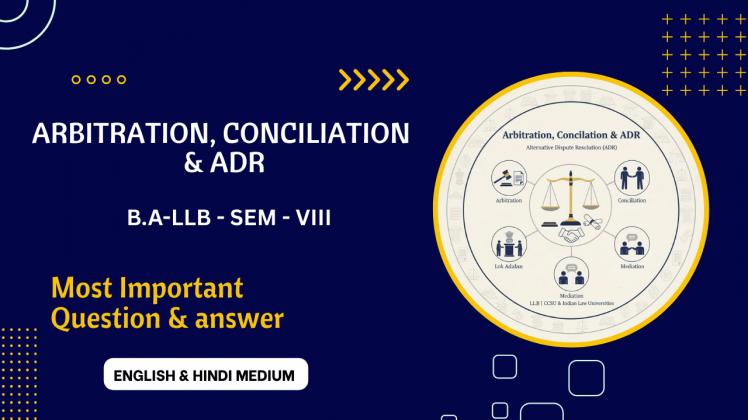
Alternative Dispute Resolution includes methods such as arbitration, conciliation, mediation, negotiation, and Lok Adalats. These mechanisms aim to resolve disputes amicably, efficiently, and with minimum formalities. ADR is based on principles of party autonomy, confidentiality, flexibility, and mutual consent.
The Supreme Court of India has consistently encouraged ADR mechanisms, recognizing them as essential tools to reduce the burden on courts and promote access to justice. Article 39A of the Constitution of India, which mandates equal access to justice, indirectly supports the use of ADR.
Arbitration
Meaning and Definition
Arbitration is a method of dispute resolution where parties agree to submit their disputes to a neutral third party called an arbitrator, whose decision (known as an award) is binding on the parties. Arbitration is a quasi-judicial process and resembles court proceedings, but it is more flexible and less formal.
Under Section 2(1)(a) of the Arbitration and Conciliation Act, 1996, arbitration means any arbitration whether or not administered by a permanent arbitral institution.
Arbitration Agreement
An arbitration agreement is the foundation of arbitration proceedings. According to Section 7 of the Act, an arbitration agreement must be in writing and may be in the form of an arbitration clause in a contract or a separate agreement. The existence of a valid arbitration agreement ousts the jurisdiction of civil courts, except where judicial intervention is permitted under the Act.
Types of Arbitration
- Domestic Arbitration – Arbitration conducted within India between Indian parties.
- International Commercial Arbitration – Arbitration involving at least one foreign party.
- Institutional Arbitration – Arbitration conducted under the rules of an arbitral institution.
- Ad Hoc Arbitration – Arbitration conducted without institutional support.
- Fast Track Arbitration – Introduced to ensure speedy resolution of disputes.
Arbitral Procedure and Award
The arbitral tribunal conducts proceedings in accordance with the agreement of the parties. Principles of natural justice, such as equal treatment and fair hearing, must be followed. The arbitral award must be in writing and state reasons unless otherwise agreed.
The arbitral award is enforceable as a decree of the court under Section 36 of the Act. Courts may set aside an award only on limited grounds under Section 34, such as fraud, violation of public policy, or lack of jurisdiction.
Conciliation
Meaning and Nature
Conciliation is a voluntary and non-binding ADR process where a neutral third party called a conciliator assists the parties in reaching an amicable settlement. Unlike arbitration, the conciliator does not impose a decision but facilitates negotiation and compromise.
Conciliation is governed by Part III (Sections 61–81) of the Arbitration and Conciliation Act, 1996.
Role of the Conciliator
The conciliator plays an active role by suggesting settlement terms, clarifying issues, and encouraging cooperation between parties. The process is informal and confidential, which helps preserve relationships, especially in commercial, family, and employment disputes.
Settlement Agreement
When parties reach a settlement through conciliation, a settlement agreement is drawn up. As per Section 74 of the Act, such an agreement has the same status and effect as an arbitral award on agreed terms and is enforceable like a court decree.
Distinction Between Arbitration and Conciliation
|
Basis |
Arbitration |
Conciliation |
|---|---|---|
|
Nature |
Adjudicatory |
Non-adjudicatory |
|
Decision |
Binding award |
Mutual settlement |
|
Role of Third Party |
Arbitrator decides dispute |
Conciliator facilitates settlement |
|
Formality |
More formal |
Informal |
|
Relationship |
May strain relations |
Preserves relations |
Other ADR Mechanisms
Mediation
Mediation involves a neutral mediator who helps parties negotiate a settlement. It is widely used in family disputes, commercial matters, and court-annexed ADR programs.
Negotiation
Negotiation is the simplest form of ADR where parties directly discuss and resolve disputes without third-party intervention.
Lok Adalats
Established under the Legal Services Authorities Act, 1987, Lok Adalats aim to provide speedy justice through compromise. Awards passed by Lok Adalats are final and binding.
Importance of ADR in India
ADR mechanisms offer several advantages:
- Speedy disposal of disputes
- Cost-effective justice
- Reduced burden on courts
- Confidentiality
- Flexibility and party autonomy
- Preservation of relationships
The judiciary has actively promoted ADR through landmark judgments and statutory amendments. Section 89 of the Code of Civil Procedure, 1908 empowers courts to refer disputes to ADR.
Conclusion
Arbitration, Conciliation, and ADR have become indispensable components of the modern Indian legal system. They reflect a progressive approach to justice delivery by emphasizing efficiency, fairness, and accessibility. For LL.B. students of CCSU and other Indian law universities, understanding ADR is crucial not only from an academic perspective but also for practical legal training. With increasing commercial transactions and globalization, ADR is set to play a vital role in shaping the future of dispute resolution in India.