
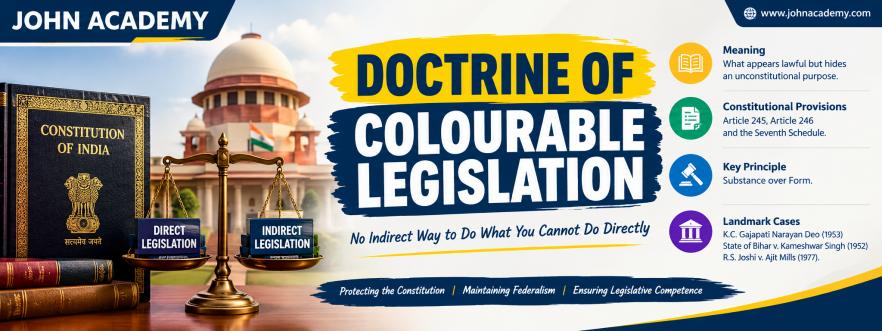
Doctrine of Colourable Legislation: Meaning, Principles, Examples and Landmark Cases
Introduction
The Doctrine of Colourable Legislation is an important principle of Indian Constitutional Law. It prevents the legislature from making laws indirectly when it does not have the constitutional power to make them directly.
In simple words, the government cannot do indirectly what it is not permitted to do directly.
The Indian Constitution distributes legislative powers between Parliament and State Legislatures. Parliament and State Legislatures must make laws within their respective constitutional powers. If a legislature tries to exceed these powers by using a different name or form for a law, the Doctrine of Colourable Legislation may be applied by the courts.
This doctrine protects the federal structure of India and maintains the supremacy of the Constitution.
1. Meaning of the Doctrine of Colourable Legislation
The word colourable means something that appears to be lawful on the surface but may conceal an unlawful purpose or constitutional defect.
The Doctrine of Colourable Legislation examines whether a legislature has exceeded its constitutional authority while making a law.
For example, suppose a State Legislature does not have the power to make a particular law because the subject falls exclusively within Parliament's legislative authority. The State Legislature cannot make that law simply by giving it a different name.
If the actual substance of the law exceeds its constitutional powers, the court may declare it unconstitutional.
Easy example: Imagine a student is prohibited from entering a classroom. The student cannot enter through the main door, so they try to enter through a window. Changing the route does not remove the restriction. Similarly, a legislature cannot avoid constitutional limitations merely by changing the form or name of a law.
However, a law is not automatically unconstitutional simply because it has an indirect effect on a subject outside the legislature's jurisdiction. The court examines its true nature, substance and constitutional validity.
2. Constitutional Basis
The Doctrine of Colourable Legislation is based on the constitutional distribution of legislative powers in India.
The following constitutional provisions are particularly relevant:
Article 245: Extent of Laws Made by Parliament and State Legislatures
Article 245 defines the territorial extent of laws made by Parliament and State Legislatures, subject to the Constitution.
Parliament can make laws for the whole or any part of the territory of India, while a State Legislature can make laws for the whole or any part of that State, subject to constitutional limitations.
Article 246: Distribution of Legislative Powers
Article 246 distributes legislative subjects between Parliament and State Legislatures through the three lists in the Seventh Schedule:
-
Union List: Subjects such as defence, foreign affairs and currency, primarily within Parliament's legislative authority.
-
State List: Subjects such as public order and police, generally within State Legislatures' authority, subject to constitutional provisions.
-
Concurrent List: Subjects such as education and forests, on which both Parliament and State Legislatures can legislate, subject to constitutional rules.
If a legislature exceeds its constitutional authority, the court may examine the law's validity.
3. Key Principle: Substance Over Form
The central principle of this doctrine is that the court looks at the real substance of a law rather than merely its name, title or outward appearance.
This is often expressed through the Latin maxim:
“Quando aliquid prohibetur ex directo, prohibetur et per obliquum.”
It means: What cannot be done directly cannot be done indirectly.
The court examines the true nature and character of the legislation, commonly described as its pith and substance, to determine whether it falls within the legislature's constitutional powers.
If the law is constitutionally valid in its substance, it does not become invalid merely because it incidentally affects a subject assigned to another legislature.
4. Important Features of the Doctrine
The Doctrine of Colourable Legislation has the following important features:
-
Constitutional limitation: It ensures that legislatures remain within their constitutional powers.
-
Indirect exercise of power: It addresses attempts to achieve through indirect means what the Constitution does not permit directly.
-
Substance over form: Courts examine the actual nature and effect of legislation rather than relying only on its title.
-
Protection of federalism: It helps maintain the division of legislative powers between Parliament and State Legislatures.
-
Judicial review: Courts can examine whether a law violates constitutional limits.
-
Legislative competence: The primary question is whether the legislature had the authority to enact the law.
Importantly, this doctrine does not mean that every law with an indirect effect is invalid. The actual constitutional competence of the legislature is the decisive consideration.
5. Landmark Supreme Court Cases
A. K.C. Gajapati Narayan Deo v. State of Orissa (1953)
This is one of the leading cases on the Doctrine of Colourable Legislation.
Facts: The validity of legislation concerning the imposition of an estate tax was challenged, and the question involved the legislature's constitutional authority to enact the law.
Judgment: The Supreme Court explained the doctrine and emphasised that the question is not whether the legislature acted with a dishonest or improper motive, but whether it had the legislative competence to enact the law.
Importance: This case established a leading explanation of the doctrine in Indian constitutional law.
Easy understanding: If a legislature has the constitutional power to make a law, an allegation that it acted with a bad motive does not by itself make the law unconstitutional. If it lacks the necessary power, changing the law's form cannot save it.
B. State of Bihar v. Kameshwar Singh (1952)
This case concerned the constitutional validity of the Bihar Land Reforms Act, 1950.
Facts: The legislation sought to abolish the zamindari system and acquire estates. Certain provisions were challenged on constitutional grounds, including allegations involving the nature of the compensation arrangements.
Judgment: The Supreme Court examined the constitutional validity of the challenged provisions. The case is associated with the application of the Doctrine of Colourable Legislation in the context of land reform legislation.
Importance: It illustrates how courts examine whether legislation complies with constitutional restrictions.
C. R.S. Joshi v. Ajit Mills Ltd. (1977)
This case concerned provisions of the Gujarat Sales Tax Act and the treatment of amounts collected by dealers as sales tax in circumstances covered by the legislation.
Judgment: The Supreme Court discussed the doctrine and reiterated that the issue is fundamentally one of legislative competence, not simply the motives of the legislature.
Importance: The case is useful for understanding the distinction between constitutional power and the purpose or policy behind legislation.
6. Difference Between Colourable Legislation and Pith and Substance
These two doctrines are related but serve different analytical purposes.
| Basis | Colourable Legislation | Pith and Substance |
|---|---|---|
| Meaning | Examines whether a legislature has exceeded its powers indirectly. | Identifies the true nature and character of a law. |
| Main question | Is the legislature constitutionally competent to enact the law? | Which legislative subject does the law substantially concern? |
| Purpose | Prevents circumvention of constitutional limitations. | Helps resolve overlaps between legislative subjects. |
| Result | A law beyond legislative competence may be invalid. | A law may remain valid despite incidental effects on another list. |
Both doctrines help courts determine whether legislation falls within the constitutional distribution of powers.
7. Why Is the Doctrine Important?
The Doctrine of Colourable Legislation is important for several reasons.
First, it protects the supremacy of the Indian Constitution. Parliament and State Legislatures derive their powers from the Constitution and cannot act beyond those powers.
Second, it maintains the federal balance by preventing one legislature from taking over subjects constitutionally assigned to another.
Third, it strengthens judicial review. Courts can examine the substance of legislation and determine whether constitutional limits have been respected.
Finally, it prevents the misuse of legislative authority. A legislature cannot avoid constitutional restrictions simply by changing the title, language or outward form of a law.
Conclusion
The Doctrine of Colourable Legislation is a significant principle of Indian Constitutional Law. Its central idea is simple: a legislature cannot do indirectly what it has no constitutional power to do directly.
The doctrine is not primarily concerned with the personal motives of lawmakers. Instead, it focuses on legislative competence and constitutional limitations.
The landmark judgment in K.C. Gajapati Narayan Deo v. State of Orissa (1953) remains particularly important for understanding this principle.
For law students, the easiest way to remember the doctrine is: Look beyond the name of the law and examine whether the legislature had the constitutional power to make it.