
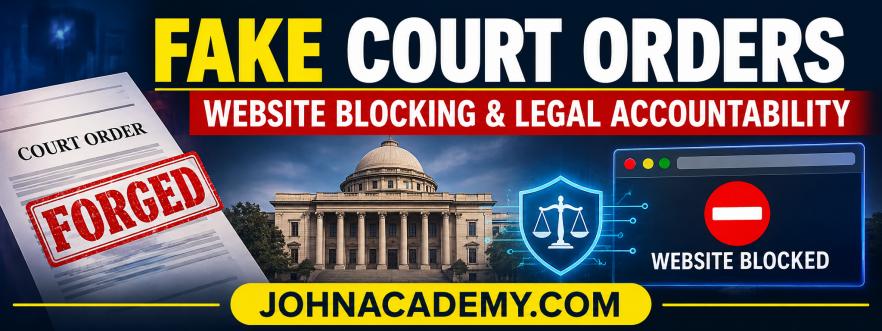
The increasing use of digital technology has created new challenges for India's judicial and administrative systems. One emerging concern is the misuse of forged court orders to influence government decisions and restrict access to online platforms.
In November 2026, a serious incident came to light when an investigation revealed that 129 betting-related websites had been blocked following allegedly forged court orders attributed to the Rajasthan High Court and Allahabad High Court.
This incident raises important questions about judicial authenticity, cybercrime, government accountability, freedom of speech and the legal safeguards governing website blocking in India.
The issue is not simply about fraudulent documents. It also highlights how weaknesses in verification systems can affect digital rights and public trust in judicial institutions.
1. The 129 Website Blocking Incident: What Happened?
In November 2026, a Reuters investigation revealed that the Department of Telecommunications (DoT) had issued website-blocking directions based on two purported High Court orders that were subsequently found to be forged.
The first document was attributed to the Rajasthan High Court and resulted in directions to block 34 websites on July 21, 2026.
The second document was presented as an order of the Allahabad High Court dated August 14, 2026. Based on this document, another 95 websites were blocked on September 2, 2026.
Together, these two incidents affected 129 websites.
Investigations revealed that the purported orders did not exist in the official judicial records. The Allahabad High Court confirmed that the document was fake and initiated police action.
The forged documents reportedly contained court seals, official-looking signatures and other features intended to make them appear genuine.
The incident demonstrated how fabricated judicial documents could potentially influence administrative decisions and restrict access to websites.
Source: Reuters investigation, November 11–12, 2026.
2. Legal Framework for Website Blocking in India
Website blocking in India is primarily governed by Section 69A of the Information Technology Act, 2000.
Under Section 69A, the Central Government or an authorised officer may direct the blocking of public access to information through any computer resource.
Such action is permitted on specified grounds, including:
-
Sovereignty and integrity of India.
-
Defence of India.
-
Security of the State.
-
Friendly relations with foreign States.
-
Public order.
-
Preventing incitement to the commission of certain cognizable offences relating to these grounds.
The provision also requires reasons to be recorded in writing.
The Information Technology (Procedure and Safeguards for Blocking for Access of Information by Public) Rules, 2009 establish the procedure and safeguards for implementing blocking directions.
These safeguards are important because website blocking can affect businesses, individuals, publishers and the public's ability to access information.
A forged court order cannot become a genuine judicial direction merely because it carries an official-looking seal or signature.
3. Role of the Supreme Court: Shreya Singhal v. Union of India (2015)
An important judgment concerning online freedom and website blocking is Shreya Singhal v. Union of India (2015).
The Supreme Court examined the constitutional validity of provisions of the Information Technology Act, including Sections 66A, 69A and 79.
The Court struck down Section 66A as unconstitutional because it violated the freedom of speech and expression guaranteed under Article 19(1)(a) of the Constitution.
However, the Court upheld Section 69A and the 2009 Blocking Rules, recognising the procedural safeguards contained in them.
The judgment emphasised that blocking must follow the prescribed legal procedure and remain within the constitutional restrictions under Article 19(2).
This decision is significant because it establishes that government restrictions on online information must have a valid legal foundation and cannot be imposed arbitrarily.
The 2026 forged-order incident highlights why these safeguards must be followed carefully.
4. Legal Consequences of Forging Court Orders
Creating or using fabricated judicial documents can attract serious criminal consequences under Indian law.
The Bharatiya Nyaya Sanhita (BNS), 2023 contains provisions dealing with cheating, forgery and the use of forged documents as genuine.
Depending on the facts and evidence, relevant provisions may include:
Section 318 – Cheating: This provision deals with dishonest or fraudulent deception causing or likely to cause wrongful loss or gain.
Section 336 – Forgery: It addresses the creation of false documents or electronic records with the intention specified under the provision.
Section 337 – Forgery of certain public records: This provision concerns forgery of specified public records and documents, including certain official and judicial records.
Section 338 – Forgery of valuable securities, wills and other specified documents: Its applicability depends on the nature of the forged document.
Section 340 – Using forged documents or electronic records as genuine: This provision addresses the dishonest or fraudulent use of forged documents as genuine.
The precise charges depend on the evidence, intention and nature of the documents involved.
In the Allahabad High Court-related investigation, police registered a case involving provisions of the BNS, including Sections 318, 336, 337, 338 and 340, along with relevant provisions of the Information Technology Act.
5. Who Should Be Held Accountable?
The incident raises questions about the responsibilities of different stakeholders.
A. Individuals Creating Fake Orders
Those responsible for preparing forged judicial documents may face criminal prosecution for forgery, cheating and other applicable offences.
B. Individuals Submitting Fake Orders
Anyone knowingly presenting fabricated court orders to government authorities to obtain an unlawful advantage may also face criminal liability.
C. Government Departments
Government authorities must establish reliable verification procedures before implementing directions based on judicial documents.
The incident highlights the importance of checking court orders against official court records and confirming their authenticity through appropriate channels.
D. Internet Service Providers
Internet Service Providers (ISPs) are responsible for complying with valid blocking directions issued under applicable law. Their compliance procedures should ensure that the directions received are authentic and legally enforceable.
However, responsibility for a fraudulent order must be determined on the basis of evidence and the applicable legal duties of each stakeholder.
6. Impact on Freedom of Speech and Digital Rights
Website blocking is not merely a technical decision. It can directly affect fundamental rights and economic interests.
Article 19(1)(a) of the Constitution guarantees freedom of speech and expression, subject to reasonable restrictions under Article 19(2).
When websites are blocked through fabricated judicial documents, the consequences may extend beyond the immediate targets.
Such incidents can:
-
Restrict access to lawful online information.
-
Cause financial losses to website operators.
-
Affect legitimate digital businesses.
-
Undermine public confidence in judicial institutions.
-
Create opportunities for misuse of administrative powers.
Therefore, website blocking must be supported by genuine legal authority and appropriate procedural safeguards.
7. Measures Needed to Prevent Fake Court Orders
The incident demonstrates the need for stronger verification mechanisms.
Some important measures include:
-
Digital Verification: Government departments should verify judicial orders through official court websites and authenticated digital records.
-
Digital Signatures: Electronic signatures and other recognised authentication mechanisms should be checked before administrative action.
-
QR Code Verification: QR codes should lead to genuine official court records rather than unrelated webpages.
-
Independent Confirmation: Where authenticity is doubtful, the concerned court registry should be contacted before implementing the direction.
-
Audit Trails: Departments should maintain records of emails, attachments, verification steps and officials responsible for processing blocking requests.
-
Accountability Mechanisms: Appropriate departmental and criminal investigations should identify how forged documents entered official decision-making processes.
These measures can reduce the risk of fraudulent documents being used to influence government action.
Conclusion
The 129 website blocking incident of 2026 exposes an important weakness in the intersection of technology, law and public administration.
The use of forged court orders to trigger government action threatens the credibility of judicial institutions and raises serious concerns about digital rights.
Section 69A of the Information Technology Act, 2000 provides a legal mechanism for website blocking, but its exercise must comply with statutory safeguards and constitutional limitations.
The Supreme Court's decision in Shreya Singhal v. Union of India (2015) remains an important constitutional foundation for protecting online freedom while permitting lawful restrictions.
Ultimately, digital governance requires more than legal authority. It requires authenticity, transparency, accountability and effective verification.
A fake court order must never be allowed to exercise the authority of a genuine court.