
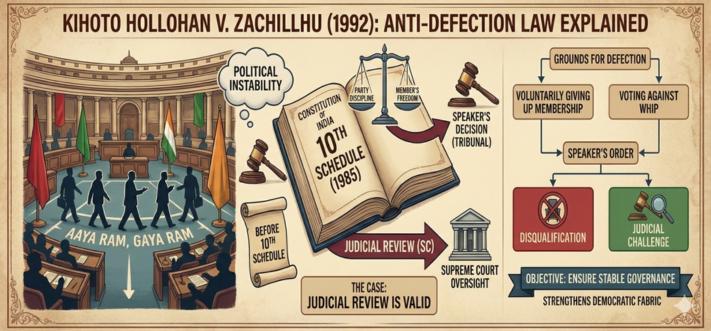
The case of Kihoto Hollohan v. Zachillhu & Others (1992) is one of the most significant constitutional judgments delivered by the Supreme Court of India. It deals with the validity, scope, and judicial review of the Anti-Defection Law, which was introduced through the 52nd Constitutional Amendment Act, 1985 by inserting the Tenth Schedule into the Constitution of India.
The judgment struck a delicate balance between political stability and democratic principles, particularly freedom of speech, dissent, and judicial review. It clarified the powers of the Speaker/Chairman in deciding disqualification matters while ensuring that such powers are not immune from constitutional scrutiny.
Background: Anti-Defection Law
Defection had become a serious political problem in India during the 1960s and 1970s. Legislators frequently changed political parties for personal or political gain, leading to unstable governments. This phenomenon was famously described as “Aaya Ram, Gaya Ram” politics.
To curb this menace, the 52nd Constitutional Amendment Act, 1985 introduced the Tenth Schedule, which provided for disqualification of Members of Parliament and State Legislatures on the ground of defection.
Under the Tenth Schedule, a member could be disqualified if:
- He voluntarily gave up membership of his political party, or
- He voted or abstained from voting contrary to the party whip without permission.
The Speaker or Chairman of the House was made the sole authority to decide disqualification petitions.
Facts of the Case
The case arose from political instability in the State of Nagaland. Several Members of the Legislative Assembly were disqualified under the Tenth Schedule for defection.
Kihoto Hollohan, along with other petitioners, challenged the constitutional validity of the Tenth Schedule, particularly:
- The power of the Speaker to decide defection cases,
- The bar on judicial review under Paragraph 7 of the Tenth Schedule,
- The alleged violation of Articles 102, 191, 136, 226, and 227 of the Constitution.
Issues Before the Court
The Supreme Court examined the following key issues:
- Whether the Tenth Schedule violates the basic structure of the Constitution.
- Whether vesting adjudicatory power in the Speaker/Chairman is constitutional.
- Whether Paragraph 7, which barred judicial review, is valid.
- Whether the Speaker’s decision is final and beyond judicial scrutiny.
Arguments of the Petitioners
The petitioners contended that:
- The Speaker is a political figure and cannot be expected to act impartially.
- Vesting judicial powers in the Speaker violates the Doctrine of Separation of Powers.
- Paragraph 7 completely excludes judicial review, which is part of the basic structure.
- The law suppresses freedom of speech and dissent of elected representatives.
Arguments of the Respondents
The Union of India argued that:
- The Anti-Defection Law is essential to maintain political stability.
- The Speaker holds a constitutional office and is expected to act neutrally.
- Judicial review would cause unnecessary delays and defeat the purpose of the law.
- Parliament has the authority to enact such provisions under its constitutional powers.
Judgment of the Supreme Court
The Supreme Court delivered a split verdict (3:2) but upheld the constitutional validity of the Tenth Schedule, subject to important limitations.
1. Validity of the Tenth Schedule
The Court held that the Anti-Defection Law is constitutionally valid and does not violate democracy. It serves a legitimate purpose by preventing political defections that undermine public confidence in the electoral process.
2. Speaker as the Adjudicating Authority
The Court upheld the role of the Speaker/Chairman as the deciding authority. It observed that:
- The Speaker occupies a high constitutional position.
- His decisions are subject to constitutional discipline.
- Mere possibility of bias is not enough to invalidate the law.
However, the Court acknowledged that the Speaker performs a quasi-judicial function while deciding defection cases.
3. Judicial Review and Paragraph 7
This was the most crucial part of the judgment.
- The Court struck down Paragraph 7 of the Tenth Schedule, which barred judicial review.
- It held that judicial review is a basic feature of the Constitution and cannot be excluded.
- Since Paragraph 7 affected the jurisdiction of the Supreme Court and High Courts, it required ratification by half of the States, which was not done.
Thus, Paragraph 7 was declared unconstitutional.
4. Scope of Judicial Review
The Court clarified that:
- Judicial review is available only after the Speaker gives a final decision.
- Courts should not interfere at an interlocutory stage.
- Review is limited to cases of:
- Mala fide intention,
- Violation of constitutional mandate,
- Breach of principles of natural justice,
- Perversity or arbitrariness.
Doctrine of Basic Structure
The judgment reaffirmed that:
- Judicial review, rule of law, and democracy are part of the basic structure.
- Parliament cannot enact laws that completely oust the jurisdiction of constitutional courts.
Thus, while political stability is important, it cannot override constitutional supremacy.
Significance of the Judgment
The case is significant for several reasons:
- Balanced Approach – It upheld the Anti-Defection Law while protecting judicial review.
- Speaker’s Role Clarified – Established the Speaker as a quasi-judicial authority.
- Strengthened Basic Structure Doctrine – Reaffirmed judicial review as inviolable.
- Guidance for Future Cases – Influenced later cases like Ravi S. Naik v. Union of India and Nabam Rebia v. Deputy Speaker.
- Democratic Accountability – Ensured that defection decisions are not politically arbitrary.
Criticism of the Judgment
Despite its importance, the judgment has faced criticism:
- Speakers often act in a partisan manner in practice.
- Delay in deciding disqualification petitions defeats the objective of the law.
- Judicial review only after final decision sometimes allows defectors to enjoy office.
These concerns led to further judicial developments and calls for reform, including suggestions to transfer adjudicatory power to an independent tribunal.
Conclusion
Kihoto Hollohan v. Zachillhu (1992) stands as a constitutional milestone in Indian parliamentary democracy. The Supreme Court successfully balanced the need for political stability with the core principles of rule of law and judicial review.
While the Anti-Defection Law continues to evolve through judicial interpretation, this judgment remains the foundation stone for understanding defections, Speaker’s powers, and constitutional accountability in India.
For law students and scholars, the case is essential to understand the interaction between constitutional amendments, basic structure, and democratic governance.