
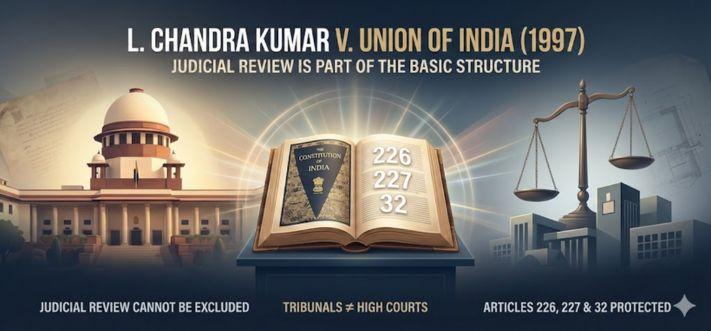
The judgment in L. Chandra Kumar v. Union of India (1997) is one of the most significant constitutional decisions delivered by the Supreme Court of India. This case clarified the constitutional position of tribunals, reaffirmed the supremacy of the High Courts and the Supreme Court, and most importantly, declared that judicial review is a part of the Basic Structure of the Constitution.
For law students, this case is a cornerstone in Administrative Law, Constitutional Law, and Judicial Process, and it is frequently asked in CCSU exams, other law universities, UGC-NET, and Judicial Services examinations.
Background of the Case
After the 42nd Constitutional Amendment Act, 1976, Articles 323A and 323B were inserted into the Constitution. These provisions empowered Parliament to establish Administrative Tribunals and other specialized tribunals to deal with service matters, taxation, labour disputes, and other technical fields.
Under these Articles:
- Parliament excluded the jurisdiction of High Courts under Articles 226 and 227
- Appeals from tribunals were allowed directly to the Supreme Court under Article 136
This resulted in:
- Weakening the role of High Courts
- Overburdening the Supreme Court
- Concerns regarding independence and effectiveness of tribunals
The constitutional validity of these provisions came under challenge in L. Chandra Kumar v. Union of India.
Issues Involved
The Supreme Court considered the following major issues:
- Whether judicial review under Articles 226, 227, and 32 can be excluded by constitutional amendments.
- Whether tribunals can replace High Courts as courts of first instance.
- Whether Articles 323A(2)(d) and 323B(3)(d) are constitutionally valid.
- What should be the constitutional position of tribunals in India.
Judgment of the Supreme Court
A seven-judge Constitution Bench delivered a landmark judgment.
1. Judicial Review is Part of the Basic Structure
The Court held that:
Judicial review under Articles 226/227 and 32 is an integral part of the Basic Structure of the Constitution.
This principle flows directly from Kesavananda Bharati v. State of Kerala (1973).
Therefore:
- Any law or constitutional amendment that removes or curtails judicial review is unconstitutional.
- Parliament cannot eliminate the power of High Courts and the Supreme Court to review legislative or administrative action.
2. Exclusion of High Court Jurisdiction is Unconstitutional
The Court struck down:
- Article 323A(2)(d)
- Article 323B(3)(d)
To the extent that they excluded the jurisdiction of High Courts under Articles 226 and 227.
The Court held that:
- High Courts are constitutional courts
- They cannot be bypassed or replaced by tribunals
3. Role and Status of Tribunals
The Court clarified that:
- Tribunals are supplementary, not substitutes, to High Courts
- Tribunals may act as courts of first instance in service and specialized matters
- However, their decisions are subject to judicial review by High Courts
This ensures:
- Uniformity of law
- Constitutional oversight
- Protection of fundamental rights
4. Direct Appeals to Supreme Court Discouraged
The Court observed that:
- Allowing direct appeals from tribunals to the Supreme Court under Article 136 overburdens the Court
- Litigants must first approach the High Court
Thus:
- High Courts act as the primary constitutional watchdogs
- Supreme Court remains a court of last resort
Impact on Administrative Law
This judgment restored:
- The central role of High Courts
- The doctrine of separation of powers
- The balance between efficiency and constitutional safeguards
It also addressed practical issues such as:
- Poor infrastructure of tribunals
- Lack of judicial independence
- Appointment of technical members without adequate safeguards
Linkage with BNS (Bharatiya Nyaya Sanhita, 2023)
Although L. Chandra Kumar is primarily a constitutional and administrative law case, its principles are deeply connected with the philosophy of BNS, 2023.
1. Fair Procedure and Rule of Law
BNS, like its predecessor IPC, operates within the constitutional framework of:
- Article 14 (Equality before law)
- Article 21 (Procedure established by law)
The decision in L. Chandra Kumar ensures that:
- Any criminal or administrative action under BNS is subject to judicial scrutiny
- Arbitrary exercise of power by authorities is checked through High Court review
2. Safeguard Against Arbitrary State Action
BNS introduces new offences and expands state power in areas such as:
- Organized crime
- National security
- Public order
Judicial review, as reaffirmed in this case, ensures that:
- Powers under BNS are exercised reasonably
- Citizens retain access to constitutional remedies
3. Access to Justice
One of the objectives of BNS is speedy and effective justice.
However, speed cannot come at the cost of constitutional safeguards.
This case guarantees that:
- Tribunals or special courts under new criminal laws cannot become final authorities
- High Courts remain open for correction of legal and constitutional errors
Critical Evaluation
Positive Aspects
- Strengthened constitutional supremacy
- Reinforced independence of judiciary
- Protected citizens’ right to constitutional remedies
Criticism
- Tribunal system still suffers from inefficiency
- High Courts may face increased workload
- Lack of uniform reform in tribunal administration
Despite criticism, the judgment prioritizes constitutional values over administrative convenience.
Conclusion
L. Chandra Kumar v. Union of India (1997) is a constitutional milestone that reaffirmed the soul of Indian democracy—judicial review.
The case makes it clear that:
- No authority is above the Constitution
- Tribunals cannot replace constitutional courts
- Judicial review is non-negotiable
For CCSU and other law university students, this case is essential to understand:
- Basic Structure Doctrine
- Tribunal jurisprudence
- Judicial independence
- Constitutional control over criminal laws like BNS, 2023
Exam Tip (CCSU & Judiciary)
📌 One-line Answer:
Judicial review under Articles 226, 227, and 32 is part of the Basic Structure and cannot be excluded.
📌 Frequently Asked Question:
“Discuss the constitutional position of tribunals after L. Chandra Kumar v. Union of India