
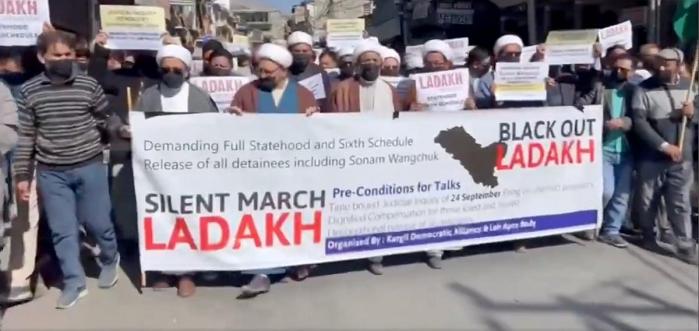
The right to peaceful assembly is one of the essential features of a democratic society. In India, citizens have the constitutional freedom to gather peacefully, express their opinions, raise public concerns and protest against government policies. This right is protected under Article 19(1)(b) of the Indian Constitution.
The Ladakh protests have brought renewed attention to the importance of this fundamental right. The movement has highlighted the constitutional relationship between public participation, democratic dissent, regional autonomy and the government's responsibility to maintain public order.
The protests in Leh on 24 September 2025, which turned violent and resulted in four deaths following police firing, raised important questions about the limits of peaceful assembly and the constitutional responsibilities of law enforcement authorities.
The Ladakh situation provides an important opportunity to understand how the Constitution protects peaceful demonstrations while allowing reasonable restrictions in the interest of public safety.
2. Background of the Ladakh Protests
In August 2019, following the constitutional changes concerning Jammu and Kashmir, the former state was reorganised into two Union Territories: Jammu and Kashmir, and Ladakh.
Ladakh became a separate Union Territory without a legislature. Subsequently, various organisations and residents began demanding greater political representation and constitutional safeguards.
The major demands of the movement include:
-
Granting statehood to Ladakh.
-
Inclusion of Ladakh under the Sixth Schedule of the Constitution.
-
Protection of local land rights and cultural identity.
-
Safeguarding employment opportunities for local residents.
-
Greater political representation and democratic participation.
-
Protection of the fragile Himalayan environment.
Two important organisations associated with the movement are the Leh Apex Body (LAB) and the Kargil Democratic Alliance (KDA).
In September 2025, protests intensified following dissatisfaction over negotiations with the Central Government. On 24 September 2025, demonstrations in Leh turned violent, resulting in deaths, injuries and damage to public and private property.
The incident led to curfew restrictions, arrests and prohibitory measures in the region.
3. Constitutional Protection under Article 19(1)(b)
Article 19(1)(b) of the Indian Constitution guarantees every citizen the right:
"To assemble peaceably and without arms."
This provision recognises peaceful assembly as a fundamental democratic freedom.
It allows citizens to:
-
Organise peaceful demonstrations.
-
Participate in public meetings.
-
Conduct peaceful marches and rallies.
-
Express collective disagreement with government policies.
-
Raise social, economic and political demands.
-
Participate in democratic movements.
The right is not limited to political organisations. Ordinary citizens, students, workers and social groups can also exercise this freedom.
However, Article 19(1)(b) does not provide an unrestricted right to assemble anywhere, at any time or under any circumstances.
4. Reasonable Restrictions under Article 19(3)
The right to peaceful assembly is subject to reasonable restrictions under Article 19(3).
The State may impose restrictions in the interests of:
-
Sovereignty and integrity of India.
-
Public order.
These restrictions are necessary to maintain peace, prevent violence and protect the rights of other citizens.
For example, authorities may regulate the location, timing, route and conditions of a public demonstration.
However, restrictions must have a legitimate constitutional basis. They should not become an arbitrary method of suppressing peaceful criticism or democratic participation.
The constitutional challenge is to maintain a balance between individual freedom and public safety.
5. Relationship between Articles 19(1)(a), 19(1)(b) and 19(1)(c)
The right to protest is not dependent on Article 19(1)(b) alone. It is supported by three important constitutional freedoms.
|
Constitutional provision |
Fundamental right |
|---|---|
|
Article 19(1)(a) |
Freedom of speech and expression |
|
Article 19(1)(b) |
Right to assemble peacefully and without arms |
|
Article 19(1)(c) |
Right to form associations or unions |
These provisions work together to protect democratic participation.
For example, when residents of Ladakh organise a peaceful demonstration demanding statehood, they exercise their freedom of expression, their right to assemble and their freedom to organise collectively.
Therefore, peaceful protest is an important constitutional instrument through which citizens can communicate their grievances to the government.
6. Important Supreme Court Judgments on the Right to Protest
The Supreme Court of India has repeatedly recognised the importance of peaceful demonstrations in a democratic society.
A. Himat Lal K. Shah v. Commissioner of Police (1973)
This is an important judgment concerning the right to hold public meetings on public streets.
The Supreme Court recognised that the State has the authority to regulate public meetings on streets. However, such regulatory powers cannot be exercised arbitrarily to completely deny the freedom of assembly.
Legal principle: The government can regulate public demonstrations but cannot impose unreasonable restrictions that destroy the constitutional right itself.
B. Anita Thakur v. Government of Jammu and Kashmir (2016)
This judgment is particularly relevant to the relationship between peaceful demonstrations and police action.
The Supreme Court recognised that peaceful demonstrations intended to communicate public grievances are protected under Articles 19(1)(a), 19(1)(b) and 19(1)(c).
The Court also explained that peaceful protest is an important feature of democratic political participation.
However, such rights remain subject to reasonable restrictions concerning public order and national interests.
Legal principle: Peaceful protest is a constitutionally protected democratic activity, provided it remains within lawful limits.
C. Mazdoor Kisan Shakti Sangathan v. Union of India (2018)
This judgment examined the conflict between the right to protest and the rights of residents and other users of public spaces.
The Supreme Court recognised that citizens have a fundamental right to organise peaceful demonstrations to communicate their grievances.
At the same time, the Court emphasised that protests must be regulated to prevent unreasonable inconvenience to the general public.
Legal principle: The right to protest must be balanced against the rights of other citizens and the need to maintain public order.
D. Supreme Court Judgment on Lawful Dissent (2025)
In a significant judgment delivered on 28 March 2025, the Supreme Court reiterated that lawful dissent and peaceful criticism of government action form an essential part of democracy.
The Court observed that peaceful protest against government decisions is an important democratic freedom, subject to the reasonable restrictions prescribed by the Constitution.
Legal principle: Criticism of government policies and peaceful dissent cannot automatically be treated as criminal conduct.
7. Section 163 of the Bharatiya Nagarik Suraksha Sanhita, 2023
Another important legal provision relevant to the Ladakh protests is Section 163 of the Bharatiya Nagarik Suraksha Sanhita (BNSS), 2023.
This provision empowers an Executive Magistrate to issue orders in urgent cases of nuisance or apprehended danger.
Such orders may restrict certain activities, including public gatherings, where immediate prevention or speedy remedy is necessary.
Section 163 BNSS replaced Section 144 of the Code of Criminal Procedure, 1973.
Its objectives include:
-
Preventing disturbances of public peace.
-
Controlling situations involving potential violence.
-
Protecting human life and public safety.
-
Preventing riots and other unlawful activities.
However, the power under Section 163 must be exercised according to law. It cannot be used as a routine mechanism to prohibit every peaceful demonstration.
Authorities must consider the circumstances, necessity and proportionality of the restrictions imposed.
8. Can the Government Completely Ban Peaceful Protests?
The government has the constitutional responsibility to maintain public order. However, this responsibility does not give it unlimited power to suppress peaceful demonstrations.
A complete prohibition on protests without sufficient justification may raise serious constitutional concerns.
The authorities should consider less restrictive alternatives, such as:
-
Allowing demonstrations at designated locations.
-
Regulating the number of participants.
-
Prescribing reasonable timings.
-
Providing alternative routes for peaceful marches.
-
Deploying adequate police personnel for crowd management.
The objective should be to regulate demonstrations rather than unnecessarily eliminate the right to assemble.
Similarly, protesters must respect the law and refrain from violence, destruction of public property and attacks on individuals or law enforcement personnel.
9. Why Are the Ladakh Protests Important for Indian Democracy?
The Ladakh protests demonstrate that fundamental rights are not merely theoretical constitutional provisions. They provide practical mechanisms through which citizens can participate in governance.
The movement raises important constitutional questions concerning:
-
Democratic representation: How should the political aspirations of residents in a geographically distinct region be accommodated?
-
Cultural protection: What constitutional safeguards can protect local traditions and identity?
-
Environmental protection: How can development be balanced with the ecological sensitivity of the Himalayan region?
-
Freedom of expression: How can citizens criticise government policies without fear of arbitrary restrictions?
-
Public order: How can authorities prevent violence while protecting peaceful demonstrators?
In March 2026, the Central Government revoked Sonam Wangchuk's detention under the National Security Act, bringing renewed attention to the demands for constitutional safeguards and greater autonomy in Ladakh. The wider movement continued to raise questions about representation and regional governance.
10. Conclusion
The Ladakh protests highlight the importance of protecting fundamental rights in a democratic country. Article 19(1)(b) guarantees citizens the freedom to assemble peacefully and without arms, while Article 19(3) permits reasonable restrictions to protect public order and national integrity.
The government must ensure that public demonstrations are regulated fairly and that peaceful protesters are not subjected to arbitrary restrictions. At the same time, citizens must exercise their constitutional freedoms responsibly and avoid violence.
The constitutional lesson from Ladakh is that democracy does not mean the absence of disagreement; it means protecting the right to express disagreement within the framework of law.
The right to peaceful assembly is therefore not merely a legal provision but an essential foundation of democratic governance in India.
11. Important Points for Law Students and AIBE Aspirants
|
Question |
Answer |
|---|---|
|
Which Article guarantees peaceful assembly? |
Article 19(1)(b) |
|
Is the right available to foreigners? |
No, it is a citizens' right |
|
Which Article permits restrictions? |
Article 19(3) |
|
Which BNSS provision deals with urgent prohibitory orders? |
Section 163 |
|
Which CrPC provision did it replace? |
Section 144 |
|
Which case recognised the right to peaceful protest? |
Anita Thakur v. Government of J&K (2016) |
|
Which case dealt with protests and public spaces? |
Mazdoor Kisan Shakti Sangathan v. Union of India (2018) |
Disclaimer: This article is intended for educational and legal awareness purposes. It does not constitute professional legal advice.