

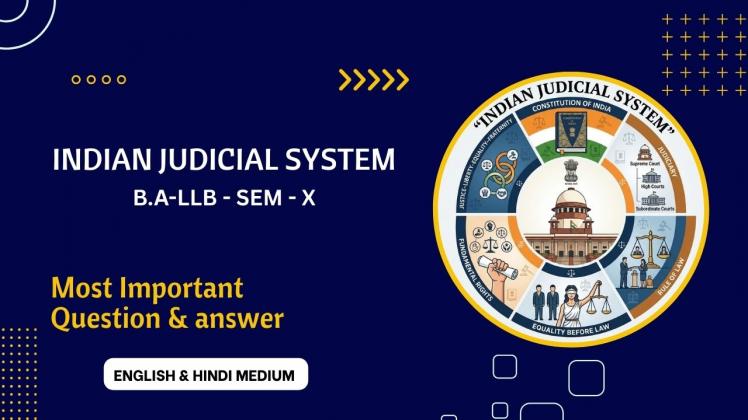
Indian Judicial System
The Indian Judicial System is one of the most vital pillars of Indian democracy. Along with the Legislature and the Executive, the Judiciary ensures that the Constitution of India is upheld and that the rule of law prevails. For BA LL.B students, understanding the structure, powers, and functioning of the judicial system is essential, as it forms the backbone of constitutional governance and legal practice in India.
India follows a single integrated judicial system, where the decisions of higher courts are binding on lower courts. The judiciary not only settles disputes but also protects fundamental rights, interprets laws, and acts as a guardian of the Constitution.
Structure of the Indian Judicial System
The Indian Judicial System has a hierarchical structure, divided into three main levels:
1. Supreme Court of India
At the apex of the judicial hierarchy stands the Supreme Court of India, established under Article 124 of the Constitution of India. It is the highest court of appeal and the final interpreter of the Constitution.
Key Features:
- Consists of the Chief Justice of India and other judges appointed by the President.
- Has original, appellate, and advisory jurisdiction.
- Its judgments are binding on all courts in India.
The Supreme Court plays a crucial role in maintaining constitutional supremacy and ensuring uniform interpretation of laws across the country.
2. High Courts
Below the Supreme Court are the High Courts, established under Article 214. Each state (or group of states) has a High Court.
Functions of High Courts:
- Exercise writ jurisdiction under Article 226 for enforcement of fundamental rights.
- Hear appeals from subordinate courts.
- Supervise and control lower judiciary within their territorial jurisdiction.
High Courts act as a bridge between the Supreme Court and subordinate courts and play a vital role in protecting civil liberties at the state level.
3. Subordinate Courts
At the grassroots level are the Subordinate Courts, which include:
- District Courts
- Sessions Courts
- Magistrate Courts
- Civil Courts
These courts deal with civil and criminal cases at the district and local level. They ensure access to justice for common citizens and form the foundation of the judicial system.
Jurisdiction of Indian Courts
The Indian judiciary exercises different types of jurisdiction:
- Original Jurisdiction – Authority to hear cases for the first time.
- Appellate Jurisdiction – Power to hear appeals against lower court decisions.
- Advisory Jurisdiction – Supreme Court gives legal advice to the President under Article 143.
- Writ Jurisdiction – Power to issue writs such as Habeas Corpus, Mandamus, Prohibition, Certiorari, and Quo Warranto.
These jurisdictions ensure that justice is not only done but also seen to be done.
Independence of the Judiciary
One of the most significant features of the Indian Judicial System is its independence. Judicial independence is essential for fair decision-making and protection of fundamental rights.
Constitutional Safeguards Include:
- Security of tenure of judges
- Fixed salaries and service conditions
- Difficult procedure for removal (impeachment)
- Separation of judiciary from executive
An independent judiciary ensures that no authority is above the law, including the government itself.
Judicial Review
Judicial Review is the power of courts to examine the constitutionality of legislative and executive actions. If any law or action violates the Constitution, the judiciary can declare it void.
This power strengthens constitutional supremacy and prevents misuse of power. Judicial review has played a transformative role in expanding the scope of fundamental rights in India.
Role of Judiciary in Protecting Fundamental Rights
The judiciary acts as the protector of Fundamental Rights guaranteed under Part III of the Constitution. Through Public Interest Litigation (PIL), courts have made justice accessible to marginalized and vulnerable sections of society.
The introduction of PIL has transformed the judiciary from a passive institution into an active instrument of social change.
Judiciary and the Rule of Law
The concept of Rule of Law means that law is supreme and applies equally to all individuals. The Indian judiciary ensures:
- Equality before law
- Accountability of authorities
- Fair trial and due process
By enforcing rule of law, the judiciary strengthens democracy and public trust in the legal system.
Challenges Facing the Indian Judicial System
Despite its strengths, the Indian Judicial System faces several challenges:
- Pendency of cases
- Delay in justice
- Judicial vacancies
- Limited infrastructure
These challenges affect the efficiency of the judiciary and demand urgent reforms, including digitization, fast-track courts, and alternative dispute resolution mechanisms.
Conclusion
The Indian Judicial System is the guardian of the Constitution and the cornerstone of democratic governance. Its hierarchical structure, wide jurisdiction, independence, and power of judicial review make it one of the most powerful judicial systems in the world. For BA LL.B students, a thorough understanding of the judiciary is indispensable for academic excellence and professional competence.
By upholding justice, protecting rights, and maintaining constitutional balance, the Indian judiciary continues to play a decisive role in shaping India as a democratic and welfare state.


.jpg)