

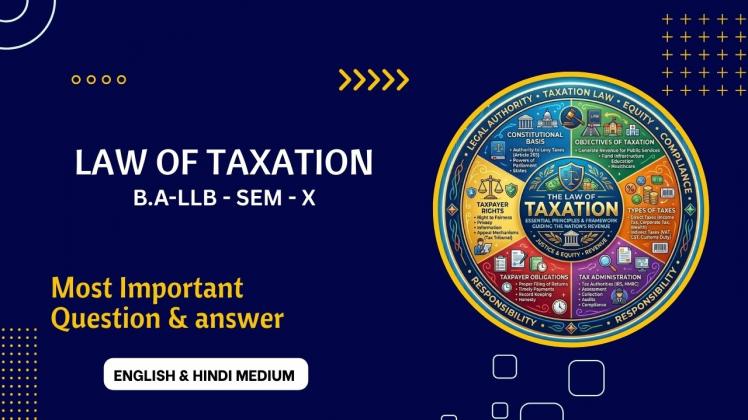
Law of Taxation
Law of Taxation – BA LL.B Semester X (Detailed Course Description with BNS)
The Law of Taxation is a compulsory and advanced paper taught in BA LL.B Semester X, aimed at providing law students with a thorough understanding of the legal principles governing taxation in India. Taxation law plays a crucial role in the functioning of the State, as it forms the backbone of public finance and economic governance. This subject enables students to comprehend how taxes are imposed, collected, administered, and enforced under Indian law, while also addressing remedies, disputes, and criminal liability arising out of tax-related offences.
The course begins with an in-depth study of the concept and nature of taxation, distinguishing tax from fee, cess, and duty. Students are introduced to the objectives of taxation, including revenue generation, redistribution of wealth, economic regulation, and social welfare. The legal meaning of “tax” and its essential elements—authority of law, compulsory exaction, and public purpose—are examined through constitutional provisions and judicial interpretations.
A significant portion of the syllabus is devoted to the constitutional framework of taxation in India. Students study Article 265 of the Constitution, which mandates that no tax shall be levied or collected except by authority of law. The distribution of taxing powers between the Union and the States under Article 246 read with the Seventh Schedule is explained in detail. The course also covers constitutional limitations on taxation, including equality under Article 14, freedom of trade under Article 301, and protection against arbitrary taxation.
The subject extensively deals with Direct Taxation, particularly Income Tax Law, which is one of the most important areas of legal practice. Students learn about the structure of the Income Tax Act, including the concepts of assessee, assessment year, previous year, residential status, and scope of total income. The course explains the heads of income—salary, income from house property, profits and gains of business or profession, capital gains, and income from other sources—along with deductions, exemptions, and set-off of losses. Practical exposure is provided through illustrations and case laws, helping students understand real-life tax computation and compliance.
In addition to direct taxes, the course covers Indirect Taxation, with special emphasis on the Goods and Services Tax (GST) regime. Students study the historical evolution from VAT, service tax, and excise duty to GST, along with the Constitution (101st Amendment) Act, 2016. Key GST concepts such as supply, levy, time and place of supply, input tax credit, registration, returns, and assessment are discussed. The course also examines the role of the GST Council and the impact of GST on Indian federalism and economic integration.
An important and contemporary dimension of the course is the study of tax administration and enforcement mechanisms. Students learn about the powers and functions of tax authorities, including search, seizure, summons, and provisional attachment. The procedural aspects of assessment, reassessment, rectification, and revision are explained to ensure that students understand both substantive and procedural tax law.
The course further addresses tax adjudication and dispute resolution, including appeals before appellate authorities, tribunals, High Courts, and the Supreme Court. Students study statutory remedies available to taxpayers and principles governing natural justice in tax proceedings. Landmark judicial decisions are analyzed to demonstrate how courts interpret taxing statutes strictly while balancing revenue interests and taxpayer rights.
A distinctive feature of the Law of Taxation (BA LL.B Sem X) is the integration of tax offences, penalties, and prosecution with the newly enacted Bharatiya Nyaya Sanhita, 2023. With the replacement of the Indian Penal Code, students are introduced to the modern criminal law framework governing economic offences, including fraud, falsification of accounts, false statements, and cheating related to tax evasion. The course explains how serious tax offences may attract criminal liability under BNS, along with penalties prescribed under tax statutes.
This integration helps students understand the intersection between taxation law and criminal law, particularly in cases involving willful tax evasion, benami transactions, shell companies, and financial fraud. The study of BNS provisions enhances awareness of compliance, accountability, and deterrence in the taxation system, which is essential in the contemporary regulatory environment.
The course also emphasizes policy objectives and economic implications of taxation, encouraging students to critically analyze tax reforms, digital taxation, faceless assessment, and international taxation trends. Comparative references and discussions on tax avoidance versus tax evasion develop analytical and interpretative skills.
By the end of the semester, students gain not only doctrinal knowledge but also practical competence in interpreting tax statutes, advising clients, drafting tax-related pleadings, and understanding prosecution risks. The subject is particularly beneficial for students aspiring to careers in tax litigation, corporate law, chartered accountancy support roles, judicial services, civil services, and academic research.
In conclusion, Law of Taxation – BA LL.B Semester X is a vital subject that combines constitutional law, economic policy, statutory interpretation, and criminal liability. With the incorporation of the BNS, 2023, the course reflects contemporary legal developments and prepares students to meet the challenges of modern taxation practice in India.
.jpg)