
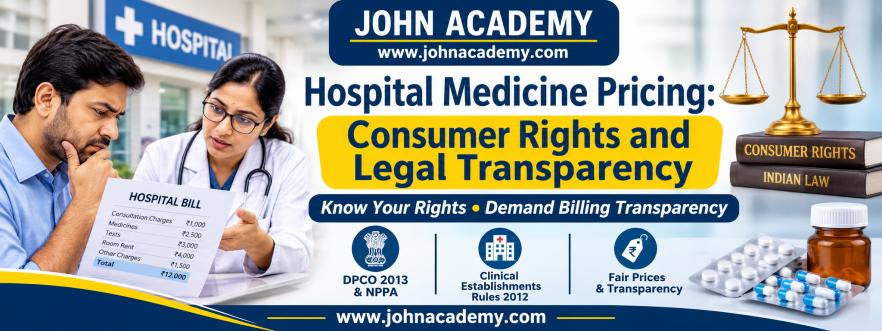
Healthcare is an essential service, and patients should not have to worry about unreasonable medical expenses while dealing with illness or emergencies. However, the cost of medicines, medical devices, injections, surgical equipment and hospital consumables can significantly increase the overall treatment bill. In many cases, patients and their families are unaware of the actual prices of medicines and the legal protections available against overcharging.
Hospital medicine pricing has therefore become an important issue concerning consumer rights, healthcare regulation and legal transparency in India. Patients have a right to receive clear information about the medicines being administered, their prices and the charges included in hospital bills.
The growing demand for transparent healthcare pricing highlights the need for stronger accountability, proper billing practices and effective implementation of existing laws.
1. Understanding Hospital Medicine Pricing
Hospital medicine pricing refers to the amount charged by hospitals for medicines, injections, surgical consumables, medical devices and other pharmaceutical products supplied during treatment.
Hospitals may procure medicines through pharmaceutical companies, distributors and authorised suppliers. The final amount charged to patients may depend on the applicable Maximum Retail Price (MRP), government price controls and the hospital's billing arrangements.
Common areas where pricing disputes arise include:
-
Medicines charged above their printed MRP.
-
Expensive injections and branded medicines.
-
Surgical consumables and medical devices.
-
Medicines supplied through hospital pharmacies.
-
Unexplained charges for medical supplies.
-
Differences between estimated and final treatment bills.
Patients should be able to understand what they are paying for instead of receiving bills containing unclear descriptions or unexplained expenses.
2. Legal Framework Governing Medicine Pricing in India
India has several legal provisions designed to regulate medicine prices and protect consumers.
A. Drugs (Prices Control) Order, 2013
The Drugs (Prices Control) Order, 2013, commonly known as DPCO, provides a framework for regulating the prices of specified medicines.
It empowers the National Pharmaceutical Pricing Authority (NPPA) to determine ceiling prices for scheduled formulations and monitor compliance with applicable price restrictions.
Manufacturers and sellers must comply with the prescribed pricing requirements. Charging above the applicable legally permitted price can attract regulatory action.
B. Essential Commodities Act, 1955
The Essential Commodities Act provides the legislative foundation for controlling the prices of essential commodities, including medicines through applicable price-control orders.
It supports government intervention to prevent unreasonable pricing and ensure the availability of essential medicines at regulated prices.
C. Consumer Protection Act, 2019
The Consumer Protection Act, 2019, protects consumers against unfair trade practices, misleading representations and deficiencies in services.
Where applicable, patients may raise complaints regarding unfair billing practices, improper charges or deficiencies in healthcare services.
The Act also provides access to consumer dispute redressal commissions for eligible complaints.
D. Clinical Establishments (Registration and Regulation) Act, 2010
The Clinical Establishments Act, 2010, and the Clinical Establishments (Central Government) Rules, 2012, establish requirements concerning the regulation of clinical establishments.
Rule 9(i) requires covered establishments to display the rates charged for each type of service and facilities available in a prominent place, in the local language and English.
Its applicability depends on the relevant state or Union Territory adopting the legislation and the applicable regulatory framework.
3. Role of NPPA in Protecting Patients
The National Pharmaceutical Pricing Authority (NPPA), functioning under the Department of Pharmaceuticals, plays an important role in monitoring medicine prices in India.
Its responsibilities include:
-
Fixing and revising ceiling prices of scheduled medicines.
-
Monitoring compliance with government-notified medicine prices.
-
Taking action against manufacturers charging above permitted prices.
-
Monitoring the availability and affordability of essential medicines.
-
Providing information about medicine prices to consumers.
Patients can use the NPPA's official website and Pharma Sahi Daam resources to check applicable medicine prices.
Importantly, the printed MRP is generally the maximum retail price, not a compulsory selling price. Medicines may be sold below MRP.
4. Right to Transparent Hospital Bills
One of the most important consumer rights is the right to understand the amount charged for medical treatment.
The Ministry of Health and Family Welfare's Charter of Patients' Rights recognises the right to transparency in healthcare rates and itemised billing.
Patients should seek clarity regarding:
-
Name and quantity of medicines supplied.
-
Price charged for each medicine.
-
Medical devices and consumables used.
-
Consultation and treatment charges.
-
Laboratory and diagnostic expenses.
-
Applicable taxes and other charges.
The Charter also recognises patients' rights to information about hospital service rates and detailed bills. Its implementation should be understood alongside the applicable state and central legal framework.
5. Can Hospitals Charge More Than the Printed MRP?
This is a common question among patients and their families.
Generally, a hospital pharmacy or seller cannot charge more than the applicable MRP for a medicine sold as a retail product, subject to the relevant legal provisions. Similarly, notified ceiling prices must be respected for medicines covered by price controls.
However, it is important to distinguish between the price of a medicine and the total cost of a hospital treatment package.
For example, a hospital bill may include:
-
Medicine costs.
-
Nursing services.
-
Doctor's professional fees.
-
Operation theatre charges.
-
Room and bed charges.
-
Medical equipment and other services.
These charges do not automatically become medicine overcharging merely because they appear alongside pharmaceutical products on the final bill.
Patients should examine the individual entries and ask the hospital to explain unclear charges.
6. Recent Government Developments on Healthcare Pricing Transparency
Healthcare pricing transparency has received renewed attention from the Central Government.
On 12 October 2026, the Ministry of Health and Family Welfare announced that the Union Health Secretary had written to the Chief Secretaries of States and Union Territories, urging effective implementation of provisions concerning the prominent display of healthcare service rates.
The initiative emphasised that patients should have easy access to information about hospital charges so that they can make informed decisions, plan their medical expenditure and avoid unnecessary billing disputes.
The Government also highlighted the importance of displaying applicable package rates for international patients.
This development reinforces the importance of implementing existing transparency requirements rather than allowing patients to remain unaware of healthcare expenses.
7. What Should Patients Do If They Face Overcharging?
Patients and their family members should follow a systematic approach when they suspect unreasonable medicine charges.
Step 1: Request an itemised bill
Ask the hospital billing department to provide a detailed statement showing medicine names, quantities and individual prices.
Step 2: Check the medicine packaging
Compare the amount charged with the printed MRP and check whether the medicine is covered by a government-notified ceiling price.
Step 3: Preserve supporting documents
Keep copies of:
-
Hospital bills.
-
Pharmacy receipts.
-
Medicine packaging.
-
Prescriptions.
-
Payment records.
-
Written communication with the hospital.
Step 4: Submit a written complaint
First approach the hospital's grievance redressal department or medical superintendent. Request a written explanation and correction of any improper charge.
Step 5: Approach the appropriate authority
Depending on the nature of the dispute, patients may approach:
-
NPPA for medicine price-control violations.
-
State Drug Controller or Drugs Inspector for medicine-related violations.
-
State health authorities for hospital regulatory complaints.
-
Consumer Disputes Redressal Commissions for eligible consumer disputes.
The NPPA specifically recognises complaints concerning overcharging and violations of applicable drug prices.
8. Challenges in Achieving Complete Pricing Transparency
Despite the existence of legal provisions, several challenges continue to affect patients.
Lack of awareness: Many patients do not know that they can request detailed bills or check medicine MRPs.
Complex billing systems: Hospital bills may contain technical descriptions that are difficult for ordinary consumers to understand.
Limited price information: Patients may not receive advance information about the approximate cost of medicines and consumables.
Emergency situations: During emergencies, families may have limited time to compare prices or question billing decisions.
Uneven implementation: Healthcare regulation is significantly dependent on state-level laws and enforcement mechanisms.
Addressing these challenges requires better public awareness, standardised billing practices, stronger monitoring and accessible complaint mechanisms.
9. Suggestions for Improving Legal Transparency
The following measures could strengthen consumer protection in the healthcare sector:
-
Hospitals should prominently display applicable medicine and service rates.
-
Patients should receive itemised bills with clear descriptions.
-
Digital billing systems should identify individual medicines and quantities.
-
Hospitals should provide written estimates for planned treatments wherever practicable.
-
Regulatory authorities should conduct regular inspections.
-
Patients should have access to effective grievance redressal mechanisms.
-
Hospitals should educate patients about available generic alternatives where medically appropriate.
Transparency should not be viewed merely as an administrative requirement. It should become an essential part of ethical and accountable healthcare delivery.
Conclusion
Hospital medicine pricing is an important consumer rights issue that directly affects the affordability and accessibility of healthcare in India. Laws such as the Drugs (Prices Control) Order, 2013, the Essential Commodities Act, 1955, the Consumer Protection Act, 2019, and the Clinical Establishments regulatory framework provide important safeguards.
However, legal protection becomes meaningful only when patients are aware of their rights and authorities effectively implement the applicable regulations.
Hospitals must maintain transparent billing practices, follow applicable medicine price controls and provide patients with clear information about treatment expenses.
Ultimately, healthcare should focus on patient welfare, fairness and accountability. Every patient deserves not only quality medical treatment but also transparency and dignity in financial matters.